Florida
Sell your land in Seminole County for cash
Parcel Buyers buys vacant lots in Seminole County for cash, including land in the Wekiwa Spring basin, where a new septic system on a lot of one acre or less must be a nitrogen-reducing system if public sewer is not available. You get a written, no-obligation cash offer within 24 hours, and closings run through an independent title company, typically in about 10 days, with no fees or commissions.
By Parcel Buyers · · Lot figures from the 2026 Florida property tax roll · How we made this page
Quick answers
- Who buys land for cash in Seminole County?
- Parcel Buyers is a direct land buyer that makes written, no-obligation cash offers on vacant lots and acreage in Seminole County, Florida, usually within 24 hours. Sales close through an independent title company, typically in about 10 days, with no fees or commissions to the seller.
- What did vacant lots in Seminole County sell for in 2025?
- In 2025, vacant lots in Seminole County sold for a median of $114,000 across 141 arm's-length sales; the middle half sold for $45,000 to $275,000.
- How many vacant lots are in Seminole County?
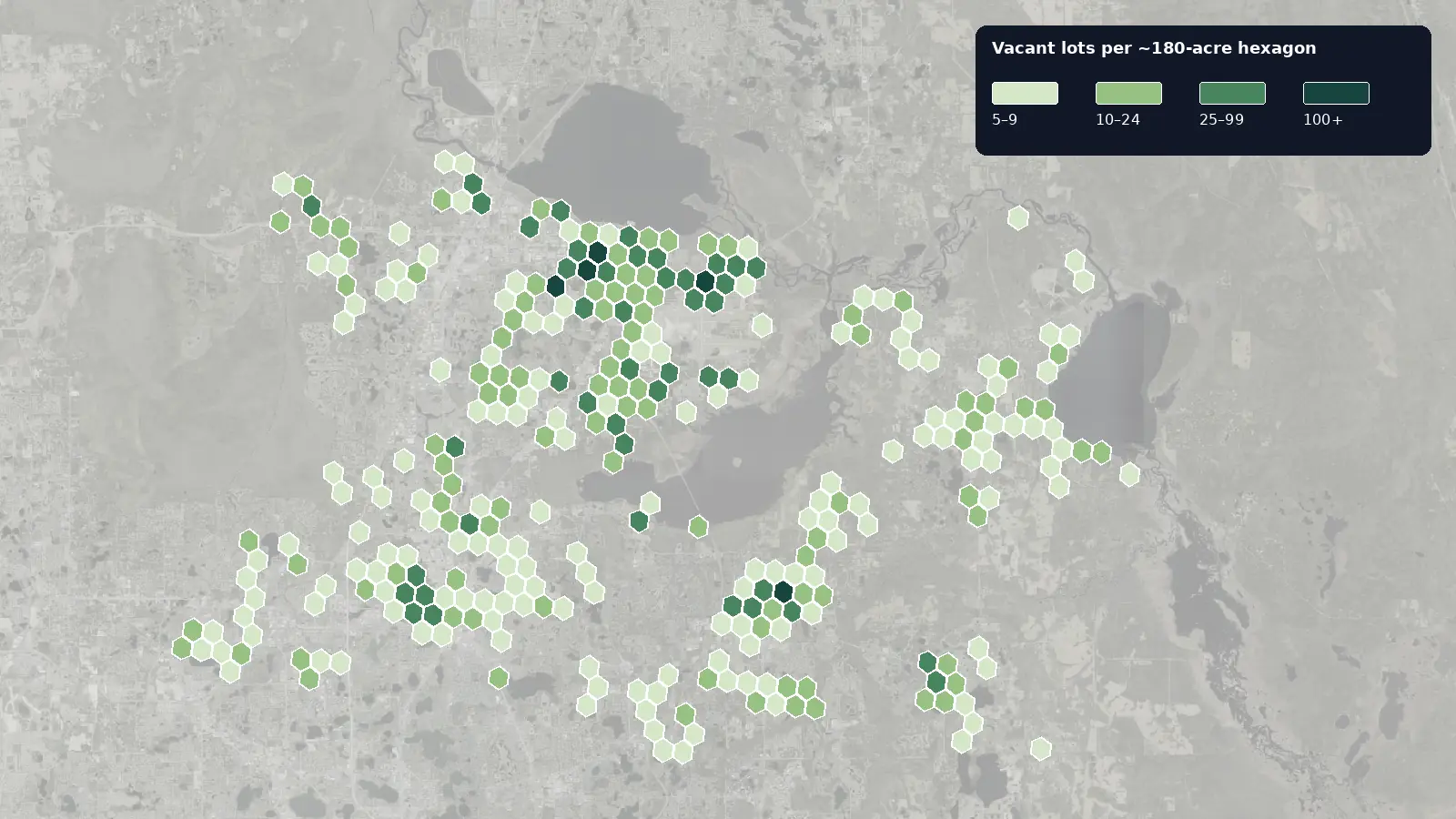
- The 2026 Florida property tax roll lists 6,159 vacant residential lots in Seminole County; 15% are patio-home lots, and the median lot is 0.23 acre.
- How is a cash offer for land in Seminole County set?
- We start from recent sales of similar lots nearby, like the 2025 prices on this page, then adjust for water and sewer, road access, flood zone, lot size and any title issues, and for the time and cost of reselling. You get one written number, not a range.
- How do I know a land buyer in Seminole County is legitimate?
- A real buyer closes through an independent, licensed title company and never asks you to pay anything up front. We never charge sellers a fee, deposit or closing-cost advance, and the title company pays you by check or wire at closing.
- Who is buying lots in Seminole County?
- In 2025, companies bought 41% of the vacant lots that sold in Seminole County, including 13% bought by homebuilders. Individuals bought the rest.
- What was the median recorded 2025 sale price by lot size in Seminole County?
- The median recorded 2025 sale price for a patio-home lot in Seminole County was $47,000 across 22 sales.
- Are vacant lot prices in Seminole County going up or down?
- Vacant lot prices in Seminole County went up 30.3%: the median moved from $87,500 across 168 recorded sales in 2024 to $114,000 across 141 recorded sales in 2025. These are recorded sales, not list prices. From January to May 2026, 38 vacant lots in Seminole County sold at a recorded median of $158,000, 5.1% lower than the same months in 2025.
- Are vacant lots in Seminole County in a FEMA high-risk flood zone?
- About 17.9% of vacant lots in Seminole County have their center point in a FEMA high-risk flood zone (effective maps dated September 28, 2007 to September 29, 2017). This is map screening, not a determination; check FEMA's Map Service Center for your parcel.
- How many vacant lots in Seminole County got a home on the tax roll in 2025?
- 872 vacant lots in Seminole County changed from vacant-residential use to a home with new-construction evidence on the 2026 preliminary tax roll.
Local data
What is land in Seminole County worth?
In 2025, vacant lots in Seminole County sold for a median of $114,000 across 141 arm's-length sales; the middle half sold for $45,000 to $275,000. [1]
These are open-market sale prices. A direct cash offer is usually lower, because a cash buyer closes in days and takes on the time and cost of reselling the lot.
Recorded 2025 sale prices by lot size in Seminole County
| Lot-size class | 2025 sales | 2025 median lot sale |
|---|---|---|
| Patio-home lot5,000–6,999 sq ft | 22 | $47,000 |
| Standard city lot7,000–8,999 sq ft | 20 | $60,000 |
| Quarter-acre lot9,000–12,999 sq ft | 18 | $79,000 |
| 5-acre ranchette210,000–279,999 sq ft | 11 | $350,000 |
| Micro lot2,000–4,999 sq ft | 10 | $31,000 |
These are open-market sale prices. A direct cash offer is usually lower, because a cash buyer closes in days and takes on the time and cost of reselling the lot.
| Vacant residential lots | 6,159 parcels classified vacant residential on the 2026 tax roll [1] |
|---|---|
| Most common lot size | Patio-home lot (5,000–7,000 sq ft): 15% of vacant lots; next, micro lot at 13%. Median lot: 0.23 acre (10,160 sq ft). [1] |
| Typical assessed value | $65,200 median just (market) value for a vacant lot; the middle half fall between $26,900 and $98,700 [1] |
| Recent lot sale prices | $114,000 median across 141 arm's-length sales of vacant lots in Seminole County (Jan 2025–Dec 2025); the middle half sold for $45,000–$275,000 [1] |
| Who bought lots in 2025 | Companies made 41% of those purchases, including 13% by homebuilders; individuals made the rest [1] |
| Owners who live elsewhere | 10% of vacant lots have an owner mailing address outside Florida (most often CA, PA, NY) [1] |
| Parcel search is separate from the deed | Search the Property Appraiser by owner, parcel number, street, facility, or subdivision. Splits, combinations, and plat recordings stay on hold until the 2026 taxes are paid. [2] |
| A certificate is a lien, not the land | Taxes become delinquent on April 1. If unpaid by June 1, certificates are auctioned starting at 18 percent interest and falling. The buyer receives a first lien, not the land. [3] |
| Tax-deed filing waits two years | A holder may apply for a tax deed two years after April 1 of the certificate year. The statute allows a $75 application fee, filed with the Tax Collector. The Clerk conducts the sale. [4],[5] |
| New septic permit is $425 | The county health department issues septic permits. Its 2025-2026 schedule lists $425 for a new tank, $135 for a private potable well, and $50 more for a springs priority-focus nitrogen-reducing review. [6],[7] |
| Springs lots of one acre or less | Since July 1, 2023, a new septic system on one acre or less inside a BMAP must reduce nitrogen if sewer is unavailable. The June 2025 Wekiwa Spring basin includes part of the county. [8],[9] |
| County utility charges are published | As of October 1, 2024, single-family water is $17.12 a month and sewer is $27.20 a month per connection. One single-family capacity fee is $2,574 for water and $3,175 for wastewater. [10],[11] |
| Effective flood map is from 2007 | Community 120289 has an effective flood map dated September 28, 2007. A flood-zone determination costs $100. Its Class 6 rating provides a 20 percent discount in special flood hazard areas and 10 percent outside them. [13],[12] |
| Rural-3 caps density at one per three | The 1991 Rural Boundary became a charter rule in 2004. Rural-3 allows at most one home per three net buildable acres. Removing land from the Rural Area takes four of five commissioners. [14],[15] |
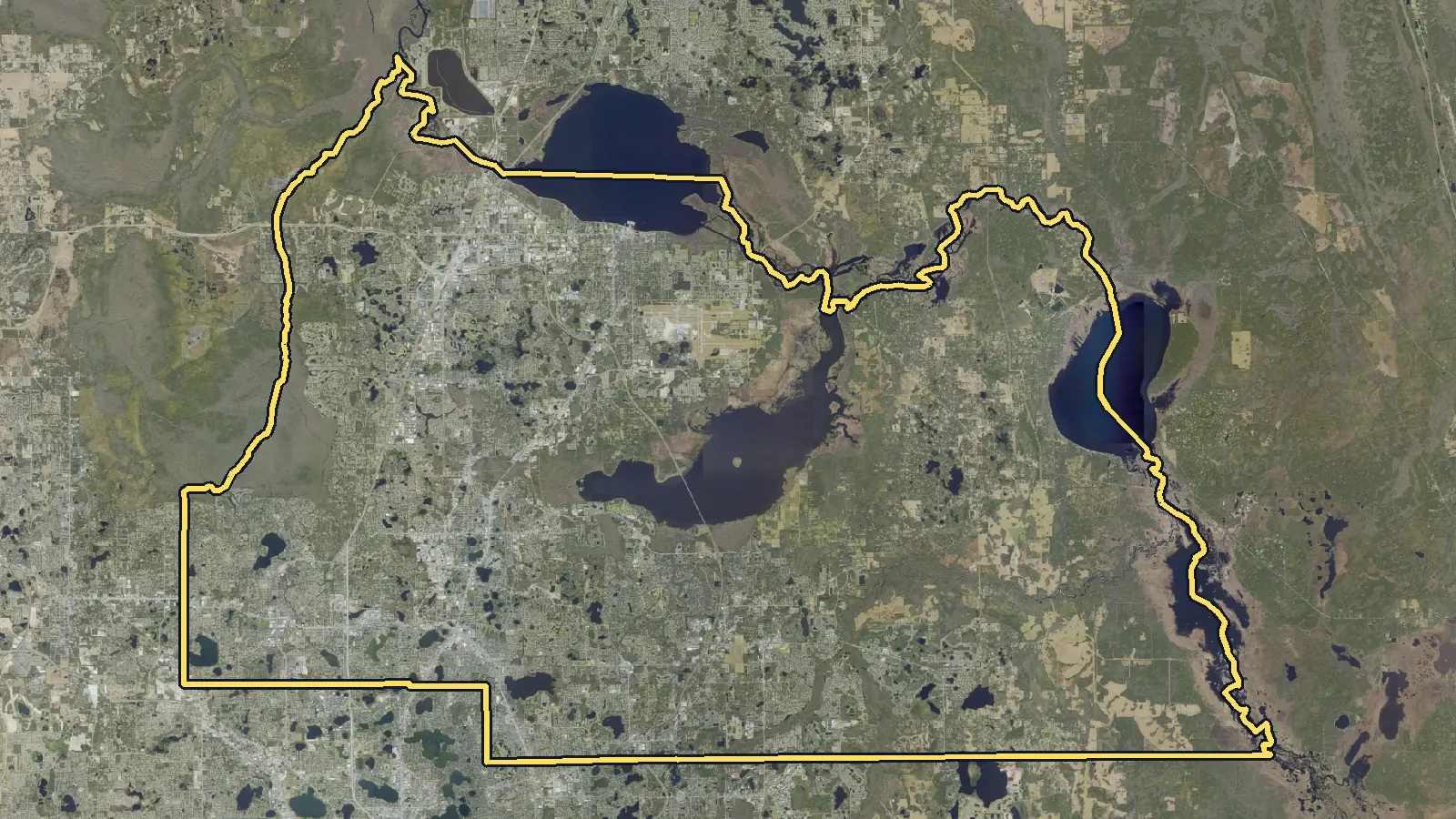
| Wekiva River | The Wekiva River runs through a 5,669-acre state aquatic preserve north of Sanford. In the county's Wekiva River Protection Area, outside East Lake Sylvan, a development order may allow no more than one home per net buildable acre. [19],[17] |
| 2025 sale price by lot size | The median recorded 2025 sale price for a patio-home lot in Seminole County was $47,000 across 22 sales. [1] |
| Lot sales, 2025 vs 2024 | 2025: 141 recorded sales, $114,000 median; 2024: 168 recorded sales, $87,500 median. Median +30.3%; count -16.1%. [1] |
| Vacant lots that got a home on the tax roll in 2025 | 872 recorded with new-construction evidence. [1] |
| Years of lot supply at the 2025 building pace | 7.1 years; simple ratio, not a forecast. [1] |
| Owner-type shares | Individuals 58.0%; companies 31.1%; trusts 7.9%; estates/heirs 2.1%; government/associations 0.9%. [1] |
| 2026 so far (Jan-May) | 38 recorded vacant-lot sales; median $158,000. [1] |
| FEMA high-risk flood-zone screen | About 17.9% of vacant lots in Seminole County have their center point in a FEMA high-risk flood zone (effective maps dated September 28, 2007 to September 29, 2017). This is map screening, not a determination; check FEMA's Map Service Center for your parcel. |
| Springs BMAP small-lot screen | About 8.1% of located vacant lots in Seminole County are 1 acre or less and have their center point in an adopted Florida springs BMAP. |
Land by town in Seminole County
| Town | Vacant lots | 2025 lot sales | Median 2025 lot sale |
|---|---|---|---|
| Sanford | 1,500 | 44 | $50,000 |
| Oviedo | 278 | 7 | — |
| Geneva | 169 | 11 | $335,000 |
| Altamonte Springs | 129 | 7 | — |
| Longwood | 103 | 6 | — |
| Casselberry | 94 | 5 | — |
| Lake Mary | 79 | 7 | — |
| Winter Springs | 69 | 1 | — |
| Chuluota | 60 | 5 | — |
| Winter Park | 11 | 3 | — |
| Maitland | 7 | 1 | — |
Florida Department of Revenue-backed rows use the 2026 preliminary tax roll. Supplemental rows retain their separately prepared source edition. Most towns are counted by property-address city, a few by ZIP code (each town page states its scope), so areas can overlap. Lots we cannot place in a town count only in the county total.
Where we buy
Areas we cover in Seminole County
- Sanford
1,500vacant lots · 2025 median lot sale $50,000
- Oviedo
278vacant lots
- Geneva
169vacant lots · 2025 median lot sale $335,000
- Altamonte Springs
129vacant lots
- Longwood
103vacant lots
- Casselberry
94vacant lots
- Lake Mary
79vacant lots
- Winter Springs
69vacant lots
- Chuluota
60vacant lots
These pages cover the largest lot markets in Seminole County. We buy land anywhere else in the county too: send the parcel details through the form below.
Selling here
How selling land works in Seminole County
The parcel file and the recorded deed answer different questions
The parcel file and the recorded deed answer different questions. The Property Appraiser search runs by owner, parcel number, street, facility name, or subdivision, and that office values the land and tracks exemptions. Splits, combinations, and plat recordings submitted there stay on hold until the 2026 taxes are paid. The Clerk of the Circuit Court and Comptroller records deeds, mortgages, and other instruments affecting title, and keeps a separate book for maps and plats. The Clerk conducts the tax-deed sale once the Tax Collector forwards a paid application. A parcel printout can point toward a deed, but it is not the recorded instrument and it is not a title opinion. Utilities, access, and title are checked on every parcel before an offer is made. An independent title company does the closing search. If the seller agrees, a lien or back taxes can be paid from the proceeds. [2],[5],[3]
The eastern Rural Area is a density rule, not an automatic rezoning
The eastern Rural Area is a density rule, not an automatic rezoning. The Board drew the Rural Boundary in the 1991 comprehensive plan, and on November 2, 2004 voters placed the Rural Area in the Home Rule Charter. A 2024 change requires at least four of five commissioners before land leaves that area. Future Land Use text limits Rural-3 to one dwelling unit per three net buildable acres. The zoning table, revised in October 2026, sets minimum lot sizes of one acre in A-1, three acres in A-3, five in A-5, and ten in A-10. The plan defines the East Rural Area as large-lot land, generally three acres or more, served mainly by wells and septic tanks. Inside the Wekiva River Protection Area, outside the East Lake Sylvan Transitional Area, a development order is not to exceed one dwelling unit per net buildable acre. The boundary did not rewrite existing zoning. [14],[15],[16],[17]
Small lots in the springs basin need nitrogen-reducing septic systems
Small lots in the springs basin need nitrogen-reducing septic systems when the system is new and sewer is missing. Since July 1, 2023, a new onsite system on a lot of one acre or less inside a basin management action plan must reduce nitrogen if public sewer is unavailable. The June 2025 Wekiwa Spring basin includes part of the county, so check the parcel, not the name on the tax bill. The county health department still issues the permit; state onsite rules have sat with the environmental agency since July 1, 2021. The 2025-2026 fee schedule lists $425 for a new tank, $350 for a repair, and $135 for a private potable well permit. A springs priority-focus nitrogen-reducing review adds $50. Accepted types include an in-ground biofilter, an NSF 245 aerobic unit, or a performance-based system. [8],[9],[6],[7]
A county utility rate sheet does not prove the lot has service
A county utility rate sheet does not prove the lot has service in the ground. The schedule effective October 1, 2024 lists $17.12 a month for single-family water and $27.20 a month for sewer, each per equivalent residential connection. Sewer charges stop after 15,000 gallons, and unincorporated accounts pay a 10 percent utility tax on water. Hookup is a separate one-time capacity fee: $2,574 for water and $3,175 for wastewater on one single-family dwelling, $5,749 combined. The code section, last amended by Resolution 2024-R-103 on September 24, 2024, counts that connection as 250 gallons a day of water and 215 of wastewater. The fee is due before pre-power or final electric service. East Rural Area lots are described as well-and-septic land. A parcel with no public water, sewer, or road work can still be sold; the missing service is a cost, not a bar to the deed. [10],[11],[17]
Flood maps and vacant-lot statistics are not a price for one parcel
Flood maps and vacant-lot statistics are not a price for one parcel. FEMA community 120289 has a map effective September 28, 2007. A flood-zone determination from the Building Division costs $100. The community is Class 6, with a 20 percent discount in special flood hazard areas and 10 percent outside them, effective May 1, 2011. Floodplain work needs a building permit. The roll covers 6,159 vacant residential parcels, median 0.23 acres (10,160 sq. ft.), value $65,200 (central half $26,900–$98,700). The leading band is the patio-home lot at 15%. In 2025, 141 qualifying vacant sales showed a median of $114,000 (central half $45,000–$275,000). Owners list Florida at 90% and another state at 10%. [12],[13],[1]
Step by step
How do I sell my land in Seminole County?
From your first message to money in hand, with nothing left out. Requesting an offer costs nothing and commits you to nothing.
See every detail of the process-
Tell us about your land
Fill out the short form (about 60 seconds) or email us. A land specialist reaches out to confirm the details, usually the same business day.
-
Get your cash offer within 24 hours
We review the property and send a written, no-obligation cash offer within 24 hours. It is a real number, not a range. Take it or leave it, with no pressure either way.
-
Sign electronically
If you accept, everyone signs the purchase agreement electronically. There is nothing to print or mail at this stage.
-
We inspect, the title company verifies
Our team inspects the land and an independent title company runs a title search for liens or taxes owed. If the land does not pass inspection, you are never charged anything.
-
Close and get paid
The title company prepares the closing documents for notarization and issues your funds by standard check, overnight check, or wire transfer. A typical sale closes in 10 days.
Questions
Selling land in Seminole County: common questions
Can I sell a vacant lot that has no public water or sewer?
Yes. A vacant lot can be sold with no county water tap and no public sewer connection. The East Rural Area is large-lot land served mainly by wells and septic tanks, so a missing main is a site fact, not a hole in the deed. A later county connection follows the October 1, 2024 schedule: $17.12 a month for water and $27.20 for sewer, plus a one-time capacity fee of $2,574 for water and $3,175 for wastewater. A new septic permit is $425 and a private well permit is $135. Those are building costs, not a condition of the deed. The only contingency on a purchase from us is a land inspection, and a failed inspection costs the seller nothing.
What does it cost each year to hold an empty lot?
There is no single flat rent for every empty lot. For fiscal year 2026/27 the countywide levy is $5.3751 per $1,000 of taxable value. The unincorporated road district adds $0.1107 per $1,000. Fire rescue is $2.7649 per $1,000 inside the fire district, which includes unincorporated land and some land inside city limits, and it is a tax on value rather than a flat vacant-lot bill. A neighborhood benefit unit is billed only where that unit exists. Unpaid taxes become delinquent on April 1 and then must be paid with certified funds.
How is a tax certificate different from a tax deed?
A tax certificate is a first lien, and a tax deed is a later sale of the land itself. Taxes become delinquent on April 1. If unpaid by June 1, the Tax Collector auctions a certificate, bidding from 18 percent interest downward. The bidder holds the lien; the owner still holds the land and clears it by repaying the tax, interest, and fees. A certificate generally lasts seven years unless bankruptcy interrupts that clock. Two years after April 1 of the issue year, the holder may apply for a tax deed. The statute allows a $75 fee, and the Clerk sells the land if it is not redeemed. Homestead certificates under $250 are struck to the county.
Which office records the deed, and what happens if I split the parcel?
The Clerk records deeds, mortgages, and other instruments affecting title, and keeps a separate book for maps and plats. The Property Appraiser handles parcel splits and combinations; its current notice says split, combination, and plat-recording requests remain on hold until the 2026 taxes are paid. A septic permit is a separate health-department process. These records answer different questions and none replaces a title search.
When must a new septic system reduce nitrogen instead of using a conventional tank?
A conventional tank is not accepted for every new system. Since July 1, 2023, a new septic system on a lot of one acre or less inside a basin management action plan must be nitrogen-reducing if sewer is not available. The June 2025 Wekiwa Spring basin includes land in the county, so the test is the parcel. The 2025-2026 fee schedule adds $50 for a springs priority-focus review on top of the $425 new-system permit. Repair and modification permits are $350 and $400. That 2023 standard targets new systems, not an automatic swap of every existing tank.
Owner resources
Guides for your situation
- Can You Build on a Vacant Lot?
Maybe. A vacant lot is buildable only if the proposed use fits the rules that apply to that parcel and the site can satisfy access, utility, environmental, and permit requirements. Start with the local planning or zoning office, confirm that the parcel is a legal lot, and get a written parcel-specific answer. A zoning label or tax parcel number alone is not approval to build.[1][2]
- Selling a Vacant Lot With Code Enforcement Liens
Yes, a Florida vacant lot with a code enforcement lien can often be sold, but first confirm the violation, daily fine, compliance status, and written payoff with the city or county that issued the order. A fine can accrue until the violator complies or judgment is entered in an enforcement suit.[1] A reduction is not automatic. A clear-title closing normally needs a current payoff and a documented satisfaction or release path.
- How to Get Rid of Land You Don't Want in Florida
The cleanest way to get rid of unwanted Florida land is usually to sell the whole parcel through a title-company closing. You can market it, request a direct cash offer, or approach an adjoining owner. A charitable or government donation works only if the intended recipient accepts the property; state and federal rules also affect the process.[3][4] Do not treat unpaid taxes or an unsigned deed as a way to abandon ownership.
Official county tools
Look up your lot in Seminole County
Check the county’s own records before making a decision. Each link opens the office or map responsible for that lookup.
| What to check | Official county tool |
|---|---|
| Property appraiser search | Open scpafl.org |
| Property tax bill lookup | Open seminolecounty.tax |
| Clerk official records | Open recording.seminoleclerk.org |
| Building permit lookup | Open scccap01.seminolecountyfl.gov |
| Code enforcement lookup | Open seminolecountyfl.gov |
| Flood map lookup | Open seminolecountyfl.gov |
Links checked 2026-10-03.
Your written offer
Get your cash offer
Four short steps, about 60 seconds. We review your property and send a written, no-obligation cash offer within 24 hours. You can take it or leave it.
What happens after you send this
- A land specialist reaches out, usually the same business day, to confirm the details.
- You get a written cash offer within 24 hours: a real number, not a range.
- You decide. Requesting an offer costs nothing and commits you to nothing.
You will never be asked to pay us anything. No deposit, no processing fee, no closing-cost advance.
How we made this page
Parcel Buyers is a land-buying company based in Florida. We buy vacant land directly from owners and publish these local pages so owners can see what land in their area is doing before they sell, to us or anyone else. We count the tax-roll figures ourselves from state data, take local rules and fees from the official sources listed below, and use AI tools to help research and draft the text. Every number links to its source, and we update the page when the data changes.
Method and sources
Tax-roll figures cover all parcels in Seminole County. Source [1] is our own count of the Florida Department of Revenue's 2026 preliminary property tax roll: "vacant residential" means land-use code 000; lot sizes use the land square footage on the roll; values are the county property appraiser's just (market) value as of January 1, 2026; sale prices count only arm's-length sales of a single lot that was vacant when it sold and was still vacant on January 1, 2026 (bulk and multi-parcel deeds removed). Page updated October 26, 2026. Lot-size sale rows use the same qualified 2025 sale cohort and canonical square-foot classes; classes with fewer than 10 sales are omitted. The reviewed 2026 recorded-sale window runs from January through May 2026; unreviewed recent sales are excluded. Flood and springs-BMAP figures screen tax-roll parcel center points, not parcel boundaries. They are aggregate map screens, not flood-zone, insurance, buildability, elevation, septic, or permitting determinations.
- [1] Florida Department of Revenue (data); Parcel Buyers (analysis), Parcel Buyers analysis of the 2026 preliminary Name-Address-Legal (NAL) property tax roll (accessed 2026-10-03)
- [2] Seminole County Property Appraiser, Seminole County Property Appraiser parcel search and 2026 split hold (accessed 2026-09-30)
- [3] Seminole County Tax Collector, Delinquent taxes and the tax certificate sale (accessed 2026-09-30)
- [4] The Florida Senate, Florida Statutes section 197.502, application for a tax deed (accessed 2026-09-30)
- [5] The Florida Senate, Florida Statutes section 28.222, clerk to be county recorder (accessed 2026-10-31)
- [6] Florida Department of Health in Seminole County, Onsite sewage permitting in Seminole County (accessed 2026-09-30)
- [7] Florida Department of Health in Seminole County, Environmental Public Health Fee Schedule 2025-2026 (accessed 2026-09-30)
- [8] Florida Department of Environmental Protection, Permitting of nitrogen-reducing onsite systems under House Bill 1379 (accessed 2026-09-30)
- [9] Florida Department of Environmental Protection, Final order adopting the June 2025 Wekiwa Spring basin management action plan (accessed 2026-09-30)
- [10] Seminole County, Water and sewer rates effective October 1, 2024 (accessed 2026-09-30)
- [11] Seminole County, Administrative Code section 20.45, water and wastewater capacity fees (accessed 2026-09-30)
- [12] Seminole County, Flood facts, FIRM date, CRS class, and flood-zone determination fee (accessed 2026-09-30)
- [13] FEMA OpenFEMA, NFIP Community Status Book, community 120289 (accessed 2026-10-02)
- [14] Seminole County, Home Rule Charter amendment and the Rural Boundary (accessed 2026-09-30)
- [15] Seminole County, Comprehensive Plan Future Land Use Goal 3, Rural-3 policy (accessed 2026-09-30)
- [16] Seminole County Planning and Development Division, Table of Zoning District Regulations, updated October 2026 (accessed 2026-10-26)
- [17] Seminole County, Comprehensive Plan introduction definitions, East Rural Area and Wekiva rural character (accessed 2026-09-30)
- [18] Seminole County, Fiscal year 2026/27 second public hearing, adopted millage (accessed 2026-09-30)
- [19] Florida Department of Environmental Protection, Wekiva River Aquatic Preserve (accessed 2026-10-07)