Franklin County, Florida
Sell your land in St. Teresa for cash
Parcel Buyers buys vacant land with a St. Teresa property address, including coastal acreage where Franklin County permits, shoreline rules, septic feasibility, well permitting and flood elevation require parcel-level review. You get a written, no-obligation cash offer within 24 hours, and closings use an independent, licensed title company, typically about 10 days after agreement, depending on title, with no fees or commissions.
By Parcel Buyers · · Lot figures from the 2026 Florida property tax roll · How we made this page
Quick answers
- Who buys land for cash in St. Teresa?
- Parcel Buyers is a direct land buyer that makes written, no-obligation cash offers on vacant lots and acreage in St. Teresa, Franklin County, usually within 24 hours. Sales close through an independent title company, typically in about 10 days, with no fees or commissions to the seller.
- How many vacant lots are in St. Teresa?
- The 2026 Florida property tax roll lists 204 vacant residential lots in St. Teresa; 18% are quarter-acre lots, and the median lot is 0.80 acre.
- How is a cash offer for land in St. Teresa set?
- We start from recent sales of similar lots nearby, like the 2025 prices on this page, then adjust for water and sewer, road access, flood zone, lot size and any title issues, and for the time and cost of reselling. You get one written number, not a range.
- How do I know a land buyer in St. Teresa is legitimate?
- A real buyer closes through an independent, licensed title company and never asks you to pay anything up front. We never charge sellers a fee, deposit or closing-cost advance, and the title company pays you by check or wire at closing.
- How much are estimated annual ad valorem taxes on a typical vacant lot in St. Teresa?
- A typical vacant lot in St. Teresa has estimated 2025 ad valorem taxes about $599 a year; most lots here also pay non-ad valorem charges (listed below).
- Are vacant lots in St. Teresa in a FEMA high-risk flood zone?
- About 72.1% of vacant lots in St. Teresa have their center point in a FEMA high-risk flood zone (effective maps dated February 5, 2014 to September 26, 2014). This is map screening, not a determination; check FEMA's Map Service Center for your parcel.
- How many vacant lots in St. Teresa got a home on the tax roll in 2025?
- 3 vacant lots in St. Teresa changed from vacant-residential use to a home with new-construction evidence on the 2026 preliminary tax roll.
Local data
St. Teresa land at a glance
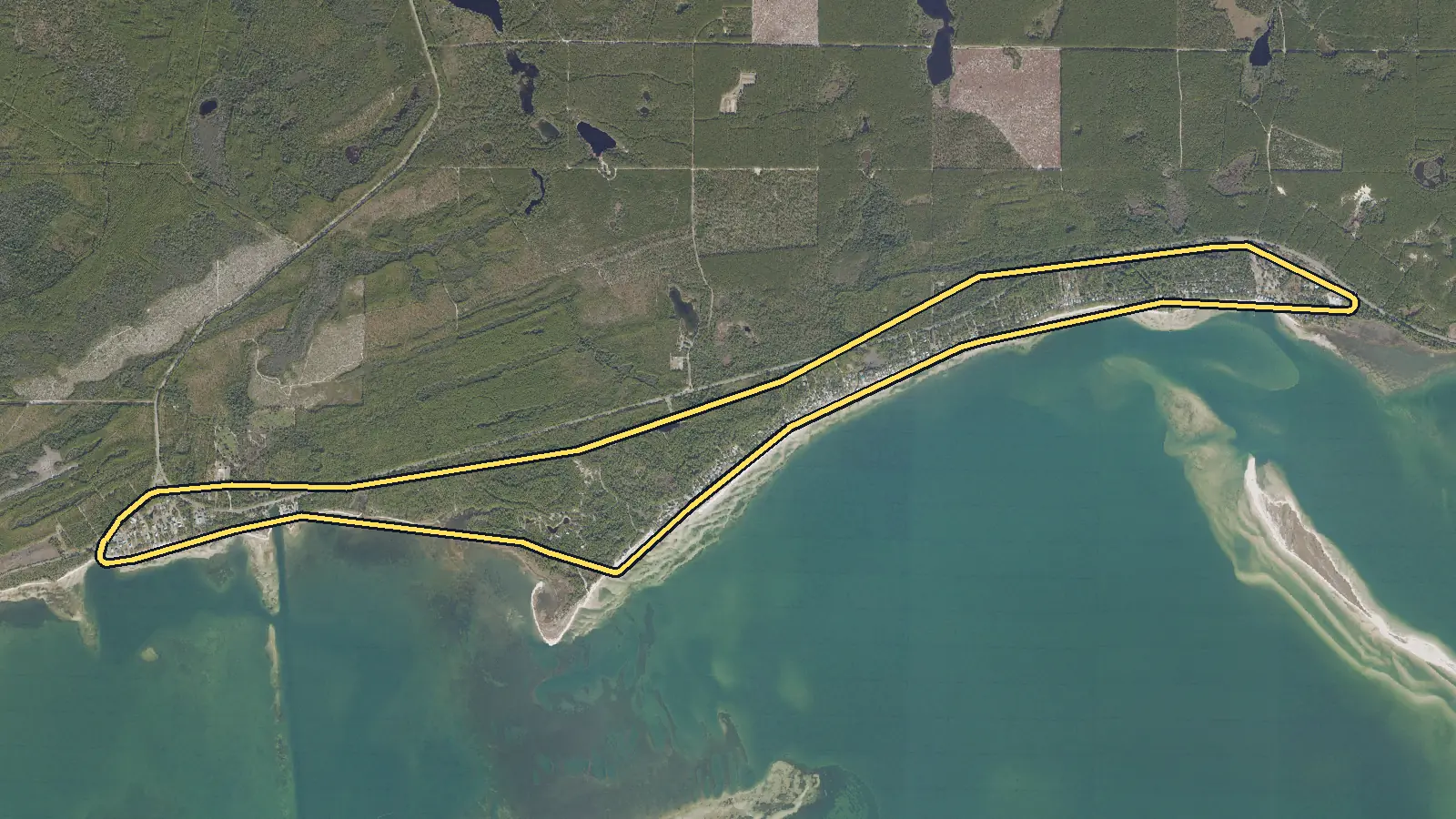
Tax-roll figures cover parcels whose property address city is St. Teresa in Franklin County. Local rules and services are sourced below.
Property addresses here read St. Teresa (86%) and St. Teresa (14%).
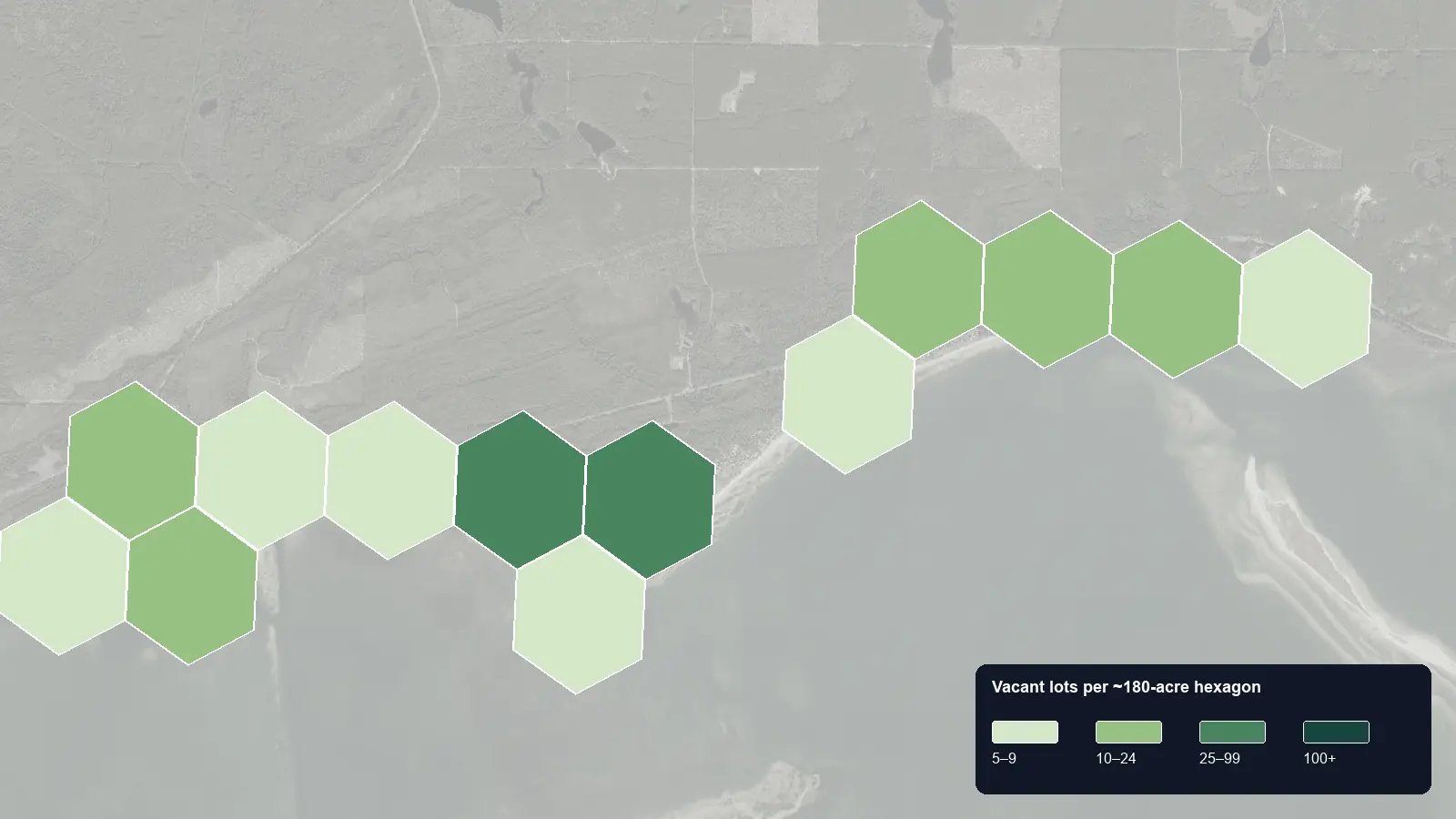
| Vacant residential lots | 204 parcels classified vacant residential on the 2026 tax roll [1] |
|---|---|
| Most common lot size | Quarter-acre lot (9,000–13,000 sq ft): 18% of vacant lots; next, mini-estate (2-3 acres) at 12%. Median lot: 0.80 acre (34,850 sq ft). [1] |
| Typical assessed value | $82,000 median just (market) value for a vacant lot; the middle half fall between $48,500 and $130,000 [1] |
| Recent lot sale prices | Too few arm's-length vacant-lot sales in 2025 to report a reliable median for St. Teresa [1] |
| Florida State University marine lab | Florida State University's Coastal and Marine Laboratory is at 3618 Coastal Highway 98. Its nearly 80-acre St. Teresa campus includes 8.5 waterfront acres and a 37-acre longleaf-pine stand. [2],[3] |
| Unincorporated Franklin County | St. Teresa is not one of Franklin County's two incorporated municipalities. County zoning and building review therefore govern parcels in this unincorporated area. [4],[2],[5] |
| County permit timing | Franklin County says complete online building applications are generally processed in 3 to 7 business days, while paper applications generally take 7 to 10 business days. [5] |
| Critical shoreline rules | The county plan applies critical-shoreline review within 150 feet of wetlands or shoreline. It limits impervious cover there to 20% and sets added onsite-sewage restrictions. [7] |
| Septic review moved to DEP | Florida DEP began handling Franklin County onsite-sewage applications on January 2, 2025. The application requires a site plan and site evaluation addressing soils and topography. [9] |
| Private wells need permits | A well permit is required before work starts, and a licensed water-well contractor may obtain it for the owner. The district says it acts within 14 days on most complete applications, with listed exceptions. [10] |
| Flood elevation drives design | Franklin County requires rated A-zone floors at least 1 foot above base flood elevation and rated VE-zone structural members at least 1 foot above it. New Special Flood Hazard Area buildings require 3 elevation certificates. [8] |
| Vacant lots that got a home on the tax roll in 2025 | 3 recorded with new-construction evidence. [1] |
| Typical annual ad valorem taxes | A typical vacant lot in St. Teresa has estimated 2025 ad valorem taxes about $599 a year; most lots here also pay non-ad valorem charges (listed below). |
| 2026 so far (Jan-May) | County-level for Franklin County: 90 recorded vacant-lot sales; median $65,000. [1] |
| FEMA high-risk flood-zone screen | About 72.1% of vacant lots in St. Teresa have their center point in a FEMA high-risk flood zone (effective maps dated February 5, 2014 to September 26, 2014). This is map screening, not a determination; check FEMA's Map Service Center for your parcel. |
| Springs BMAP small-lot screen | About 0% of located vacant lots in St. Teresa are 1 acre or less and have their center point in an adopted Florida springs BMAP. |
Pricing
What is a lot in St. Teresa worth?
These are open-market sale prices. A direct cash offer is usually lower, because a cash buyer closes in days and takes on the time and cost of reselling the lot.
See what similar lots sold for
What moves the price in St. Teresa
Unincorporated status puts Franklin County in charge
Florida State University describes St. Teresa as a small unincorporated town, and Franklin County lists only Apalachicola and Carrabelle as incorporated municipalities. That places building and zoning review with Franklin County rather than a St. Teresa city hall. The county says complete online permit applications generally take 3 to 7 business days and paper applications 7 to 10 business days. Those targets do not establish that a lot is buildable. A survey, zoning review, wetlands and shoreline information, access, septic or sewer plan, well or water source and flood-elevation design may all be needed before a complete application exists. [2],[4],[5],[6]
Shoreline setbacks can reduce usable ground
Franklin County's comprehensive plan creates a critical-shoreline review area within 150 feet of wetlands or shoreline. Within that area, it limits impervious cover to 20%. The plan prohibits septic systems within 75 feet and allows only aerobic systems from 75 to 150 feet, subject to other requirements. It also generally prohibits onsite systems on lots under 1 acre, with limited exceptions for certain older lots. Those measurements can materially change a coastal parcel's house location, wastewater design and usable area. A seller should not treat gross acreage as buildable acreage without a survey and environmental review. [7],[6]
Water and wastewater are parcel questions
A St. Teresa address does not establish a public water or sewer connection. Franklin County lists area utility contacts and says parcels without service should use the state septic and water-management-district well processes. Florida DEP began processing Franklin County onsite-sewage applications on January 2, 2025; its review uses a site plan, soils, topography and a site evaluation. A well permit is required before work starts, and a licensed water-well contractor may obtain it for the owner. The district says it acts within 14 days on most complete applications, with listed exceptions. Those approvals and construction costs can separate two otherwise similar coastal lots. [6],[9],[10]
Limited sales do not show a direction
The 2025 qualifying vacant-lot sales in this property-address scope are limited, so they do not establish a dependable trend and no sale median is published here. The tax roll shows a median recorded lot size of 0.80 acres, with quarter-acre lots forming the largest measured group at 18%; its median property-appraiser just value is $82,000. Those statistics do not identify shoreline setbacks, wetlands, usable elevation, septic suitability, well feasibility, public utility availability or legal access. Each of those parcel facts can affect a builder's budget and the resulting cash offer. [1],[7],[8],[9],[10]
Common situations
Selling land in St. Teresa in these situations
You inherited coastal acreage
Inherited St. Teresa land can be sold before the heirs commission a home design or install utilities. The important first step is identifying the parcel, ownership chain and any estate documents, not assuming that gross acreage equals usable acreage. Franklin County advises owners to use a survey showing setbacks, wetlands, septic and well locations when asking about buildability. We check utilities, access and title before offering, and electronic signing or a mail-away closing through an independent, licensed title company is available to each heir. [6],[7]
The lot has no confirmed public utilities
Yes. Parcel Buyers buys vacant land with no water, sewer or road work. For a St. Teresa-address parcel, the county directs owners to verify public service rather than infer it from the community name. If service is unavailable, state septic and district well approvals can become part of a future homesite plan. Our land inspection is the only contingency, and a failed inspection costs the seller nothing. [6],[9],[10]
You live outside Florida
You can sell without traveling to Franklin County. Electronic signing and a mail-away closing through an independent, licensed title company are available, and payment can be made by check or wire. Closing is typically about 10 days after the purchase agreement is signed, depending on title. If liens or back taxes appear in the title work, they can be paid from sale proceeds at closing with the seller's consent.
Step by step
How do I sell my land in St. Teresa?
From your first message to money in hand, with nothing left out. Requesting an offer costs nothing and commits you to nothing.
See every detail of the process-
Tell us about your land
Fill out the short form (about 60 seconds) or email us. A land specialist reaches out to confirm the details, usually the same business day.
-
Get your cash offer within 24 hours
We review the property and send a written, no-obligation cash offer within 24 hours. It is a real number, not a range. Take it or leave it, with no pressure either way.
-
Sign electronically
If you accept, everyone signs the purchase agreement electronically. There is nothing to print or mail at this stage.
-
We inspect, the title company verifies
Our team inspects the land and an independent title company runs a title search for liens or taxes owed. If the land does not pass inspection, you are never charged anything.
-
Close and get paid
The title company prepares the closing documents for notarization and issues your funds by standard check, overnight check, or wire transfer. A typical sale closes in 10 days.
Questions
Selling land in St. Teresa: common questions
Is St. Teresa an incorporated city?
No. Florida State University describes St. Teresa as a small unincorporated town, and Franklin County identifies only Apalachicola and Carrabelle as incorporated municipalities. Franklin County therefore handles zoning and building review for St. Teresa land. The property-address scope used on this page is not a surveyed neighborhood boundary.
Who issues building permits for St. Teresa land?
Franklin County's Building Department handles the county permit process. It says complete online applications generally take 3 to 7 business days and paper applications 7 to 10 business days. That review time begins with a complete filing; unresolved zoning, shoreline, wetlands, wastewater, access or flood questions can require additional work.
Will a St. Teresa lot need a well and septic system?
That cannot be decided from the address alone. Franklin County lists area utility contacts and says parcels without service should use the DEP septic and water-management-district well processes. DEP reviews soils, topography and the site plan. A well permit is required before work begins, and a licensed water-well contractor may obtain it for the owner.
How close can development be to the shoreline?
Franklin County applies critical-shoreline review within 150 feet of wetlands or shoreline. Its plan limits impervious cover there to 20%, prohibits septic within 75 feet and permits only aerobic systems between 75 and 150 feet, subject to the full code and agency review. A current survey and wetland line are essential before laying out a home.
What special assessments apply to a St. Teresa vacant lot?
Check the current tax bill, county records and title work for the exact parcel. The official sources reviewed document county permitting, shoreline, flood, septic and well requirements but do not publish a current blanket MSBU, MSTU, CDD or drainage-district charge for every St. Teresa-address vacant lot. A nearby bill should not be copied to the subject parcel.
Owner resources
Guides for your situation
- Can You Build on a Vacant Lot?
Maybe. A vacant lot is buildable only if the proposed use fits the rules that apply to that parcel and the site can satisfy access, utility, environmental, and permit requirements. Start with the local planning or zoning office, confirm that the parcel is a legal lot, and get a written parcel-specific answer. A zoning label or tax parcel number alone is not approval to build.[1][2]
- How to Sell Land During a Divorce
Florida land can be sold during a divorce when the people with authority to convey title sign and the sale follows every applicable agreement and court order. Divorce law may treat land as marital even when only one spouse appears on the deed.[1][2] If ownership, signing authority, or the division of proceeds is unsettled, have a Florida attorney and the closing title company resolve those issues before closing.
- Can You Sell Land With a Lien?
Yes. Land with a lien can often be sold, but signing a deed does not by itself erase a valid claim. The lien may need to be paid, released, discharged, or otherwise resolved under the law that applies. With the seller's consent, an approved payoff can come from sale proceeds at closing. If the balance or lien is wrong, dispute it before closing and require proof of the cure.
More places in Franklin County
Your written offer
Get your cash offer
Four short steps, about 60 seconds. We review your property and send a written, no-obligation cash offer within 24 hours. You can take it or leave it.
What happens after you send this
- A land specialist reaches out, usually the same business day, to confirm the details.
- You get a written cash offer within 24 hours: a real number, not a range.
- You decide. Requesting an offer costs nothing and commits you to nothing.
You will never be asked to pay us anything. No deposit, no processing fee, no closing-cost advance.
Nearby areas we buy
- Alligator Point
375 vacant lots · 2025 median lot sale $76,500
- St. James
375 vacant lots · 2025 median lot sale $28,200
- Franklin County
6,600 vacant lots countywide
How we made this page
Parcel Buyers is a land-buying company based in Florida. We buy vacant land directly from owners and publish these local pages so owners can see what land in their area is doing before they sell, to us or anyone else. We count the tax-roll figures ourselves from state data, take local rules and fees from the official sources listed below, and use AI tools to help research and draft the text. Every number links to its source, and we update the page when the data changes.
Method and sources
Tax-roll figures cover parcels whose property address city is St. Teresa. Source [1] is our own count of the Florida Department of Revenue's 2026 preliminary property tax roll: "vacant residential" means land-use code 000; lot sizes use the land square footage on the roll; values are the county property appraiser's just (market) value as of January 1, 2026; sale prices count only arm's-length sales of a single lot that was vacant when it sold and was still vacant on January 1, 2026 (bulk and multi-parcel deeds removed). Page updated October 5, 2026. Exact cross-roll matching found that 6.4% of current vacant lots lacked a unique prior-roll match; parcel splits, combinations, renumbering, and missing IDs are not guessed. Holding-cost estimates use 2025 taxable values and 2025 millage for FDOR vacant-residential code 000 parcels. They cover ad valorem taxes only, not a parcel-specific bill or non-ad valorem assessments. The reviewed 2026 recorded-sale window runs from January through May 2026; unreviewed recent sales are excluded. County-level figures are used on this place page. Flood and springs-BMAP figures screen tax-roll parcel center points, not parcel boundaries. They are aggregate map screens, not flood-zone, insurance, buildability, elevation, septic, or permitting determinations.
- [1] Florida Department of Revenue (data); Parcel Buyers (analysis), Parcel Buyers analysis of the 2026 preliminary Name-Address-Legal (NAL) property tax roll (accessed 2026-10-03)
- [2] Florida State University, FSU Coastal and Marine Laboratory Strategic Plan 2018-2028 (accessed 2026-10-05)
- [3] Florida State University, Contact and visit the FSU Coastal and Marine Laboratory (accessed 2026-10-05)
- [4] Franklin County, Franklin County official website (accessed 2026-10-05)
- [5] Franklin County Building Department, Permits and licenses (accessed 2026-10-05)
- [6] Franklin County Planning and Zoning, Planning and zoning rules and regulations (accessed 2026-10-05)
- [7] Franklin County Planning and Zoning, Franklin County Comprehensive Plan (accessed 2026-10-05)
- [8] Franklin County Building Department, Flood information and parcel map (accessed 2026-10-05)
- [9] Florida Department of Environmental Protection, Onsite sewage permitting FAQ (accessed 2026-10-05)
- [10] Northwest Florida Water Management District, Water well permitting process (accessed 2026-10-05)