Arizona
Sell your land in Graham County for cash
Graham County's vacant-coded lots sit in the Gila Valley farm belt below the Pinaleno Mountains, many tied to older farm-town subdivisions rather than one large modern development. Parcel Buyers makes a written, no-obligation cash offer on lots like these within 24 hours, with closing through an independent title company in about 10 days and no fees or commissions charged to you.
By Parcel Buyers · · Lot figures from the 2027 Arizona parcel and assessment data · How we made this page
Quick answers
- Who buys land for cash in Graham County?
- Parcel Buyers is a direct land buyer that makes written, no-obligation cash offers on vacant lots and acreage in Graham County, Arizona, usually within 24 hours. Sales close through an independent title company, typically in about 10 days, with no fees or commissions to the seller.
- How many vacant lots are in Graham County?
- The 2027 Arizona parcel and assessment data lists 4,291 vacant residential lots in Graham County; 18% are acreage tract (10+ acres)s, and the median lot is 1.00 acre.
- How is a cash offer for land in Graham County set?
- We review the lot itself, including its size, location, access, available services, title and the time and cost of a direct purchase. You get one written number, not a range.
- How do I know a land buyer in Graham County is legitimate?
- A real buyer closes through an independent, licensed title company and never asks you to pay anything up front. We never charge sellers a fee, deposit or closing-cost advance, and the title company pays you by check or wire at closing.
Local data
What is land in Graham County worth?
| Vacant residential lots | 4,291 parcels classified vacant residential on the 2027 Arizona parcel and assessment data [1] |
|---|---|
| Most common lot size | Acreage tract (10+ acres) (435,600–+ sq ft): 18% of vacant lots; next, quarter-acre lot at 12%. Median lot: 1.00 acre (43,595 sq ft). [1] |
| Mount Graham International Observatory | Mount Graham International Observatory sits in the Pinaleno Mountains inside Coronado National Forest, run by the University of Arizona's Steward Observatory. The surrounding mountain forest is federal land, separate from any county vacant-lot inventory. [2] |
| County Assessor sets full cash value | Arizona law has each county Assessor locate, classify and value taxable property in that county. The Graham County Assessor does that work locally; it does not set tax rates or collect payments. [3] |
| State roll vs. our vacant rule | Arizona's 2026 Abstract of the Assessment Roll lists 19,717 total parcels in Graham County, with 7,589 in the broader legal class covering vacant land and agricultural property together, a wider group than our narrower vacant-lot count. [4] |
| Arizona's two-part tax calendar | Arizona normally splits the real-property tax bill in half: due October 1 and March 1, delinquent after 5 p.m. on November 1 and May 1, with a single-payment rule when the full bill is $100 or less. [5] |
| Tax liens can run for years | A tax lien buyer can ask a court to foreclose the right to redeem starting three years after the lien sale and up to ten years after it, but the owner can still redeem at any time before a treasurer's deed is issued. [6],[7] |
| Standard deed recording fee | Arizona law sets the standard county recorder fee at $30 per instrument for most documents, plus a smaller fee for certified copies. The same statute applies in every Arizona county, including Graham. [8] |
| Small wells still need a notice | Arizona lets a small non-irrigation well pump up to 35 gallons a minute without a full water right, but the owner must still file a notice of intention to drill before work starts. [9],[10] |
Data: Mohave County Assessor's Office, Pinal County Assessor's Office, Cochise County Assessor, Santa Cruz County Assessor, Pima County Assessor, Graham County Assessor and La Paz County Assessor. Counts, medians and shares only; no owner names, parcel numbers, addresses or row-level data are published.
Where we buy
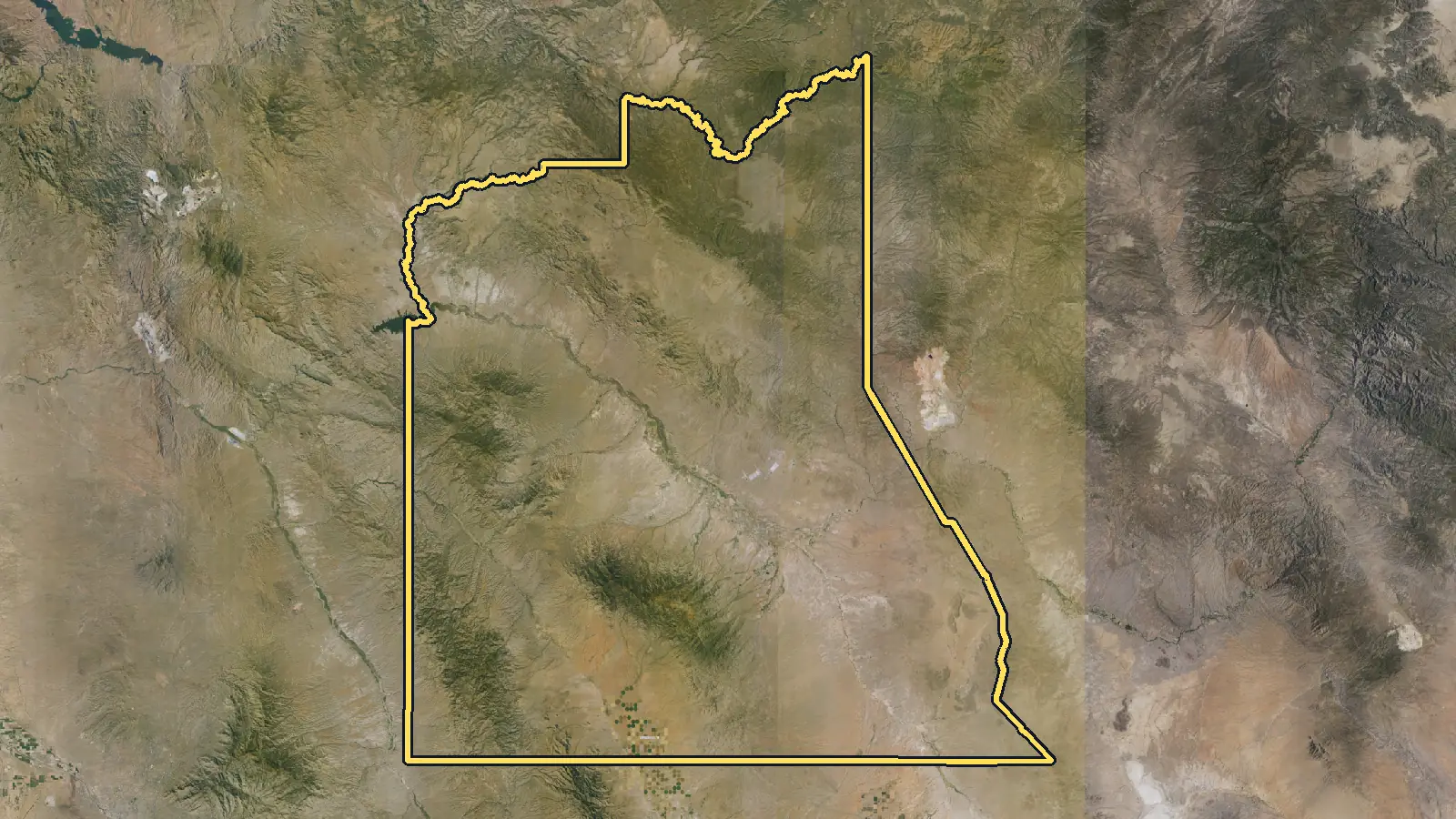
Areas we cover in Graham County
- Safford
1,769vacant lots
- Pima (Graham County)
1,092vacant lots
These pages cover the largest lot markets in Graham County. We buy land anywhere else in the county too: send the parcel details through the form below.
Selling here
How selling land works in Graham County
Graham's vacant lots read as farm-town inventory
Graham County's vacant-lot count reads as farm-town inventory, not one big modern subdivision: 4,291 parcels carry the county's own Vacant account-type code on its free GIS layer, each kept only after a positive-acreage check and a screen that drops government and association owners. A random centroid sample from that set came back with no hit on a federal structures map, the stand-in check used here since the layer has no improvement field of its own. A typical lot runs close to 1.00 acres, about 43,595 square feet, and 18% of lots land in the acreage tract (10+ acres) band. Full cash value and owner mailing state are simply absent from this source; that is a hole in the free data, not proof the land carries no value or that every owner lives in state, so neither question can be answered from this page alone. [11]
Verify who governs, and where the forest line sits
Verify jurisdiction before assuming county rules apply. Arizona law has the county Assessor identify and value taxable property locally, while permitting and zoning for land outside an incorporated city or town is a separate county function. Part of Graham County's land base sits inside Coronado National Forest, including the Pinaleno Mountains that host Mount Graham International Observatory; federal forest boundaries do not move with a parcel's legal description, so a lot near the forest edge needs its own boundary check rather than a map guess. A parcel's exact zoning, access and permitting path should be confirmed with the county before a sale moves forward. [3],[2]
A missed tax bill in Graham follows a set legal path
A missed Graham County tax bill does not jump straight to losing the land. Arizona's half-year billing puts the first installment on October 1 and the second on March 1, with delinquency kicking in once November 1 and May 1 pass without payment. From there, an unpaid account can move to the county's tax lien sale, and a lien certificate by itself is only a claim against the parcel, never a transfer of title. Years can pass before a lien purchaser gets a court to cut off the owner's right to pay it back, and the owner keeps that right until an actual treasurer's deed changes hands. Liens or back taxes owed on a parcel can be settled out of the sale proceeds at closing, with the seller's consent. [5],[6],[7]
Three county offices, three different jobs
Graham County splits land records across three offices with three different jobs. The Assessor locates, classifies and values taxable property, nothing more. Deeds, releases and liens get filed with the Recorder, under Arizona's flat statewide charge of roughly $30 a document for most filings. The Treasurer, separately, only tracks whether the tax bill tied to a parcel is paid or past due. None of the three, on its own, confirms whether a lot has usable access, working utilities or a septic path. Parcel Buyers checks those items itself before making an offer, and closing runs through an independent, licensed title company. [8]
Check well and septic rules before counting on either
Check well and septic rules early, since Graham County's own vacant-lot layer carries no utility or improvement field at all. Arizona law lets a small non-irrigation well pump up to 35 gallons a minute without a full permitted water right, but state law still requires a filed notice of intention to drill before work starts on most wells. A vacant-coded lot can already carry a mobile home or RV that the assessor's layer does not reflect in any value or improvement field, so a site visit or septic and well record check matters more than the parcel code. [9],[10]
Step by step
How do I sell my land in Graham County?
From your first message to money in hand, with nothing left out. Requesting an offer costs nothing and commits you to nothing.
See every detail of the process-
Tell us about your land
Fill out the short form (about 60 seconds) or email us. A land specialist reaches out to confirm the details, usually the same business day.
-
Get your cash offer within 24 hours
We review the property and send a written, no-obligation cash offer within 24 hours. It is a real number, not a range. Take it or leave it, with no pressure either way.
-
Sign electronically
If you accept, everyone signs the purchase agreement electronically. There is nothing to print or mail at this stage.
-
We inspect, the title company verifies
Our team inspects the land and an independent title company runs a title search for liens or taxes owed. If the land does not pass inspection, you are never charged anything.
-
Close and get paid
The title company prepares the closing documents for notarization and issues your funds by standard check, overnight check, or wire transfer. A typical sale closes in 10 days.
Questions
Selling land in Graham County: common questions
Why is there no price or value line anywhere on this Graham County page?
Two fields never made it into Graham's free parcel feed: county full cash value and any 2025 sale price. We cannot publish numbers a county database does not carry, and a missing field is not the same as zero value or zero sales. Our written cash offer comes from our own inspection of your parcel, not from a county spreadsheet column.
Can I sell a Graham County lot if I'm not sure whether it has well or septic service?
Yes. Many vacant-coded lots in rural Arizona counties have no confirmed well or septic. Our purchase has one contingency, our own land inspection, and a failed inspection costs you nothing. We check utilities, access and title ourselves before making a written offer.
What happens if my Graham County property taxes are behind?
Arizona taxes become delinquent after set dates each year, and an unpaid lien can eventually go to a tax lien sale. A lien is not a deed and does not transfer ownership by itself, though it can lead to a foreclosure action years later. Liens or back taxes can be paid from the sale proceeds at closing, with your consent.
Do I need a survey to sell vacant land in Graham County?
Not always. A survey is not legally required to sell land, though a title company may ask for one if the legal description is unclear. We review the recorded legal description and parcel record ourselves as part of our inspection before closing.
How much does it cost to record the deed when I sell my lot?
Arizona's standard statewide recording fee is $30 per instrument for most documents, under the same fee schedule that applies in every county, including Graham. In a Parcel Buyers sale, the independent title company handling closing takes care of recording.
Owner resources
Guides for your situation
- Can You Sell Land With a Lien?
Yes. Land with a lien can often be sold, but signing a deed does not by itself erase a valid claim. The lien may need to be paid, released, discharged, or otherwise resolved under the law that applies. With the seller's consent, an approved payoff can come from sale proceeds at closing. If the balance or lien is wrong, dispute it before closing and require proof of the cure.
- Can You Build on a Vacant Lot?
Maybe. A vacant lot is buildable only if the proposed use fits the rules that apply to that parcel and the site can satisfy access, utility, environmental, and permit requirements. Start with the local planning or zoning office, confirm that the parcel is a legal lot, and get a written parcel-specific answer. A zoning label or tax parcel number alone is not approval to build.[1][2]
- Selling Land With Boundary or Survey Problems
Land with a boundary or survey problem can still be offered for sale, but closing may depend on how the buyer, lender, and title insurer handle it. The contract and closing requirements determine whether a survey is needed. A fence does not by itself establish the record boundary. A survey can identify gaps, overlaps, occupation lines, and encroachments; a competing Florida title claim may require a quiet-title action.[1][6][7]
Your written offer
Get your cash offer
Four short steps, about 60 seconds. We review your property and send a written, no-obligation cash offer within 24 hours. You can take it or leave it.
What happens after you send this
- A land specialist reaches out, usually the same business day, to confirm the details.
- You get a written cash offer within 24 hours: a real number, not a range.
- You decide. Requesting an offer costs nothing and commits you to nothing.
You will never be asked to pay us anything. No deposit, no processing fee, no closing-cost advance.
How we made this page
Parcel Buyers is a land-buying company based in Florida. We buy vacant land directly from owners and publish these local pages so owners can see what land in their area is doing before they sell, to us or anyone else. We count the tax-roll figures ourselves from state data, take local rules and fees from the official sources listed below, and use AI tools to help research and draft the text. Every number links to its source, and we update the page when the data changes.
Method and sources
Parcel and assessment figures cover all parcels in Graham County. Source [1] is our own aggregate count of public parcel records from the named Arizona county assessor. A place scope may be a ZIP area, assessor market area or normalized subdivision family; use the exact scope and do not treat it as municipal limits or a buildability finding. No free sale-price source was available for this area, so no sale row is shown. Vacant-lot counts use mohave: use codes 0001-0004 and 0011-0014, improvement value 0, non-exempt, positive acreage, with government and HOA owners excluded in-query. Pinal: use codes 0011, 0013 and 0014 with legal class 02RL, with government and HOA owners excluded in-query. Cochise: use_code 0011 or 0013 and accttype Vacant. Santa Cruz: IMPVAL=0 and LANDVAL>0, excluding county-owned, under-0.05-acre, and HOA records. Vacant nonresidential and agricultural parcels are not derived (0). Pima: parcel use 0011, 0012, 0013 or 0014 with positive GIS acreage. Graham: account type Vacant with positive GIS acreage. La Paz: property use code 13 or 14 with positive acreage. Government and HOA owners are excluded in-query in all three; because none of these three layers carries an improvement-value field, each county was screened with a seeded 150-centroid sample against the FEMA/ORNL USA Structures public layer (Pima 1/150, Graham 0/150, La Paz 4/150). Lot sizes use mohave PARCEL_SIZE acres; Pinal LANDSF square feet or STATEDAREA acres when blank; Cochise acres; Santa Cruz Acreage. Acre fields are multiplied by 43,560 and bucketed with the Parcel Buyers lot-size chart ([low, high) square feet). Values use county full cash value on the current record: Mohave FULL_CASH_VALUE, Pinal CNTASSDVAL, Cochise fcv and Santa Cruz FCV. These are assessor values, not sale prices or buildability findings. Pima full cash value (FCV). Graham and La Paz publish no value field, so their value row is withheld. Owner locations use owner mailing-address state on the county record; in_state = Arizona; blank state = unknown. Treat medians as a guide to county records, not as an offer or an appraisal. Page updated November 7, 2026.
Data: Mohave County Assessor's Office, Pinal County Assessor's Office, Cochise County Assessor, Santa Cruz County Assessor, Pima County Assessor, Graham County Assessor and La Paz County Assessor. Counts, medians and shares only; no owner names, parcel numbers, addresses or row-level data are published.
- [1] Mohave County Assessor's Office, Pinal County Assessor's Office, Cochise County Assessor, Santa Cruz County Assessor, Pima County Assessor, Graham County Assessor and La Paz County Assessor (data); Parcel Buyers (analysis), Arizona county assessor public parcel services (Mohave, Pinal, Cochise, Santa Cruz, Pima, Graham and La Paz) (accessed 2026-11-06)
- [2] Mount Graham International Observatory, University of Arizona, About MGIO (accessed 2026-11-07)
- [3] Arizona Department of Revenue, Property Tax (accessed 2026-11-07)
- [4] Arizona Department of Revenue, 2026 State and County Abstract of the Assessment Roll (accessed 2026-11-07)
- [5] Arizona State Legislature, A.R.S. 42-18052: Due dates and times; delinquency (accessed 2026-11-07)
- [6] Arizona State Legislature, A.R.S. 42-18152: When lien may be fully redeemed (accessed 2026-11-07)
- [7] Arizona State Legislature, A.R.S. 42-18201: Action to foreclose right to redeem (accessed 2026-11-07)
- [8] Arizona State Legislature, A.R.S. 11-475: Fees; exemptions (accessed 2026-11-07)
- [9] Arizona State Legislature, A.R.S. 45-596: Notice of intention to drill (accessed 2026-11-07)
- [10] Arizona State Legislature, A.R.S. 45-454: Exemption of small non-irrigation wells (accessed 2026-11-07)
- [11] Graham County GIS Office, Graham_County_Parcels_New, Parcels1 (layer 7) (accessed 2026-11-07)