Tennessee
Sell your land in Marion County for cash
Parcel Buyers buys vacant lots and land for cash in Marion County, including unincorporated tracts where the county has no zoning but later construction still requires building and septic review. You get a written, no-obligation cash offer within 24 hours, and closings run through an independent, licensed title company, typically about 10 days after the purchase agreement is signed, with no fees or commissions.
By Parcel Buyers · · Lot figures from the 2026 Tennessee parcel and assessment data · How we made this page
Quick answers
- Who buys land for cash in Marion County?
- Parcel Buyers is a direct land buyer that makes written, no-obligation cash offers on vacant lots and acreage in Marion County, Tennessee, usually within 24 hours. Sales close through an independent title company, typically in about 10 days, with no fees or commissions to the seller.
- What did vacant lots in Marion County sell for in 2025?
- In 2025, vacant lots in Marion County sold for a median of $158,100 across 294 arm's-length sales; the middle half sold for $70,800 to $307,400.
- How many vacant lots are in Marion County?
- The 2026 Tennessee parcel and assessment data lists 6,206 vacant residential lots in Marion County; 21% are mini-estate (2-3 acres)s, and the median lot is 1.53 acre.
- How is a cash offer for land in Marion County set?
- We start from recent sales of similar lots nearby, like the 2025 prices on this page, then adjust for water and sewer, road access, flood zone, lot size and any title issues, and for the time and cost of reselling. You get one written number, not a range.
- How do I know a land buyer in Marion County is legitimate?
- A real buyer closes through an independent, licensed title company and never asks you to pay anything up front. We never charge sellers a fee, deposit or closing-cost advance, and the title company pays you by check or wire at closing.
- Who is buying lots in Marion County?
- In 2025, companies bought 8% of the vacant lots that sold in Marion County, including 2% bought by homebuilders. Individuals bought the rest.
- What was the median recorded 2025 sale price by lot size in Marion County?
- The median recorded 2025 sale price for a mini-estate (2-3 acres) in Marion County was $253,200 across 94 sales.
Local data
What is land in Marion County worth?
In 2025, vacant lots in Marion County sold for a median of $158,100 across 294 arm's-length sales; the middle half sold for $70,800 to $307,400. [1]
These are open-market sale prices. A direct cash offer is usually lower, because a cash buyer closes in days and takes on the time and cost of reselling the lot.
Recorded 2025 sale prices by lot size in Marion County
| Lot-size class | 2025 sales | 2025 median lot sale |
|---|---|---|
| Mini-estate (2-3 acres)70,000–139,999 sq ft | 94 | $253,200 |
| Estate parcel (3-5 acres)140,000–209,999 sq ft | 25 | $134,000 |
| One-acre homesite40,000–45,999 sq ft | 23 | $158,600 |
| Acre-plus46,000–51,999 sq ft | 22 | $156,500 |
| 1.25-acre homesite52,000–57,999 sq ft | 21 | $180,000 |
| 1.33-acre homesite58,000–63,999 sq ft | 20 | $149,100 |
| 5-acre ranchette210,000–279,999 sq ft | 17 | $80,000 |
| 1.5-acre homesite64,000–69,999 sq ft | 12 | $245,800 |
| Small acreage tract (7-10 acres)280,000–435,599 sq ft | 11 | $78,000 |
| Acreage tract (10+ acres)435,600+ sq ft | 11 | $120,000 |
| Near-acre34,000–39,999 sq ft | 11 | $157,500 |
These are open-market sale prices. A direct cash offer is usually lower, because a cash buyer closes in days and takes on the time and cost of reselling the lot.
| Vacant residential lots | 6,206 parcels classified vacant residential on the 2026 Tennessee parcel and assessment data [1] |
|---|---|
| Most common lot size | Mini-estate (2-3 acres) (70,000–140,000 sq ft): 21% of vacant lots; next, 5-acre ranchette at 10%. Median lot: 1.53 acre (66,650 sq ft). [1] |
| Typical appraised value | $65,600 median appraised value for a vacant lot; the middle half fall between $37,100 and $145,000 [1] |
| Recent lot sale prices | $158,100 median across 294 arm's-length sales of vacant lots in Marion County (Jan 2025–Dec 2025); the middle half sold for $70,800–$307,400 [1] |
| Who bought lots in 2025 | Companies made 8% of those purchases, including 2% by homebuilders; individuals made the rest [1] |
| Owners who live elsewhere | 32% of vacant lots have an owner mailing address outside Tennessee (most often FL, GA, CA) [1] |
| Unincorporated zoning | The Marion County FAQ says there is no zoning on unincorporated land. Some plats still have covenants or a homeowners association recorded with the Register of Deeds. [3],[4] |
| Building code and setbacks | On January 1, 2020, Marion County adopted the 2018 International Codes for unincorporated land. House setbacks are 40 feet in front and 15 feet on the side and rear, measured from the property lines. [5] |
| State septic permits | TDEC issues septic permits, and they stay valid for 3 years. The Marion County building office does not issue them, run perc tests, or write system-verification letters. [5] |
| Flood-zone floor height | In an established flood zone, the finished floor must be 2 feet above base flood elevation, and equipment 1 foot above it. The building official is the flood administrator for unincorporated land. [7],[4] |
| New-lot size minimums | New subdivision lots need at least 7,500 square feet with public water and sewer, 15,000 with public water and septic, or 25,000 with a private well and septic. [8] |
| Nickajack Reservoir | TWRA says this Tennessee River impoundment was created in 1967. At full summer pool it covers 10,370 acres and 192 miles of shoreline, and TVA operates it. The county website names Nickajack Lake. [12],[2] |
| State property-tax dates | The Comptroller's statewide schedule says taxes are due the first Monday in October. February 28 is the last day without interest, and March 1 is the delinquency date. [9] |
| Prentice Cooper State Forest | The 26,945-acre Prentice Cooper State Forest lies in Marion County along the Tennessee River Gorge. About 6,939 acres are unregulated scenic zones intended to protect the gorge viewshed. [13] |
| 2025 sale price by lot size | The median recorded 2025 sale price for a mini-estate (2-3 acres) in Marion County was $253,200 across 94 sales. [1] |
Where we buy
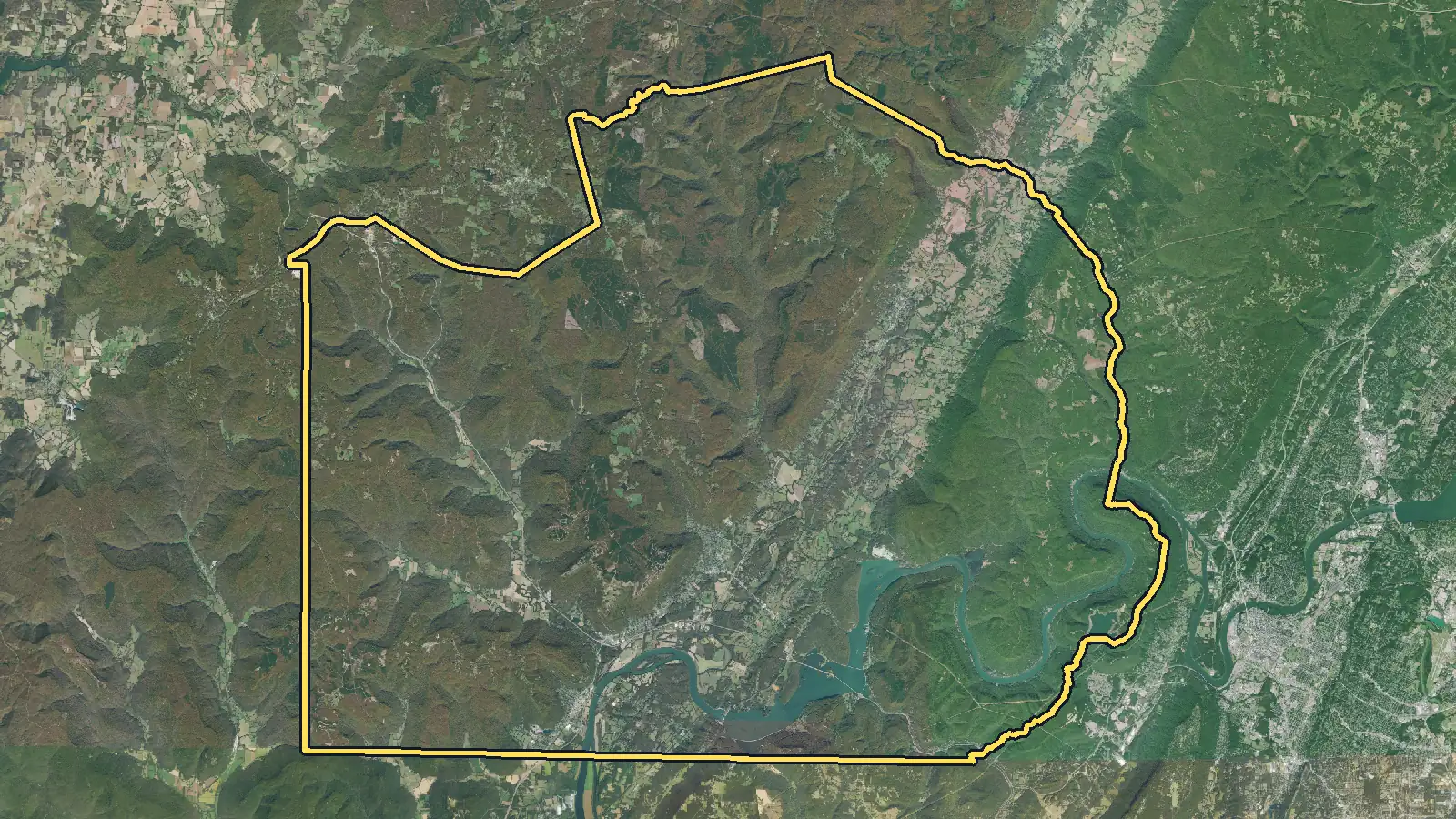
Areas we cover in Marion County
- River Gorge Ranch
883vacant lots · 2025 median lot sale $256,500
- Jasper Highlands
678vacant lots · 2025 median lot sale $140,000
- South Pittsburg
258vacant lots
- Jasper
210vacant lots
These pages cover the largest lot markets in Marion County. We buy land anywhere else in the county too: send the parcel details through the form below.
Selling here
How selling land works in Marion County
Unincorporated land has no zoning
Unincorporated land has no zoning. The Marion County FAQ says that plainly, then notes that some plats still have covenants, restrictions, or a homeowners association. Those papers should be recorded with the Register of Deeds, which looks them up from the state tax map and parcel number. That office also records warranty deeds, deeds of trust, and plats. It does not write the deed or run a certified title search. The building office permits only unincorporated property. Land inside a city is permitted by that city. No zoning does not cancel a deed limit, so the recorded rules still control what can be built. [3],[4]
A house still needs a building permit
A house on unincorporated land still needs a building permit from Marion County. Effective January 1, 2020, the building official enforces the 2018 International Codes. Two exceptions are written down: section 2904 of the residential code, on sprinklers, and the choice to use 2009 insulation values. House setbacks are 40 feet in front and 15 feet on the side and rear, measured from the property lines, not from the road. Buildings of 200 square feet and larger need a permit, and so do decks, in-ground pools, and mobile homes. The permit fee is not a flat rate. It is set after plan review, and it is not refundable. A card payment adds a 3% processing fee. Electrical permits are a separate state permit. [5],[6]
Septic permits come from the state
Septic permits come from the state, not the Marion County building office. TDEC issues them, they stay valid for 3 years, and the county procedures send applicants to https://tdec.tn.gov/septic. The building office cannot run a perc test or write a verification letter, and it does not keep those records. A county note dated August 6, 2018 says state water-resources staff are no longer housed in Marion County. On a new plat, the subdivision regulations require at least 25,000 square feet for a private well and septic, 15,000 square feet for public water and septic, and 7,500 square feet for public water and sewer. The tank must sit at least 50 feet from a well. Those sizes apply to new subdivision lots. For a house permit, the county separately requires a TDEC permit and receipt, or verification of an existing system. [5],[8]
The valley, the river, and flood zones
The valley, the river, and flood zones all limit where a house can sit. The Marion County website describes a drive through the valley, with mountains and Nickajack Lake, and the gorge of the Tennessee River along Highway 41. Sequatchie Cave is a 133-acre natural area in Marion County, designated in 2001, in the Sequatchie Valley Physiographic Province. TWRA says Nickajack Reservoir was impounded on the Tennessee River in 1967. At full summer pool it covers 10,370 acres and 192 miles of shoreline. TVA operates it. In an established flood zone, the finished floor must be 2 feet above base flood elevation and equipment 1 foot above it. The building official administers those flood rules on unincorporated land. River ground, moving soil, or a questionable bluff may also need a geotech report. A new plat cannot put a house in the floodway, and each new lot needs a flood-free building site. [2],[11],[12],[7],[5],[8]
What the 2025 lot sales show
Accepted 2025 lot sales in Marion County show a median of $158,100, higher than the median appraised value of $65,600. That sale median is not an exact market price. 294 is not every 2025 sale. These are accepted warranty-deed lot sales of land vacant when sold, one parcel per deed, at $1,000 or more; the middle half falls within $70,800–$307,400. The Assessor of Property sets the appraised value, and the middle of those appraisals is $37,100–$145,000. 21% of vacant lots are in the mini-estate (2-3 acres) size. The median lot is 1.53 acres (66,650 square feet) across 6,206 vacant residential parcels. 32% of owners have a mailing address outside Tennessee. Florida mailing addresses are the largest out-of-state group. The Comptroller updates the county parcel file weekly. [10],[4]
Step by step
How do I sell my land in Marion County?
From your first message to money in hand, with nothing left out. Requesting an offer costs nothing and commits you to nothing.
See every detail of the process-
Tell us about your land
Fill out the short form (about 60 seconds) or email us. A land specialist reaches out to confirm the details, usually the same business day.
-
Get your cash offer within 24 hours
We review the property and send a written, no-obligation cash offer within 24 hours. It is a real number, not a range. Take it or leave it, with no pressure either way.
-
Sign electronically
If you accept, everyone signs the purchase agreement electronically. There is nothing to print or mail at this stage.
-
We inspect, the title company verifies
Our team inspects the land and an independent title company runs a title search for liens or taxes owed. If the land does not pass inspection, you are never charged anything.
-
Close and get paid
The title company prepares the closing documents for notarization and issues your funds by standard check, overnight check, or wire transfer. A typical sale closes in 10 days.
Questions
Selling land in Marion County: common questions
Can I sell my lot in Marion County if it has no water or sewer?
Yes. Parcel Buyers buys vacant lots with no water, sewer, or road work, and we check utilities, access, and title on every parcel before offering. A house built later still needs a TDEC septic permit, valid for 3 years, because the county office does not issue septic permits or run perc tests. A new subdivision lot on a private well and septic has to be at least 25,000 square feet. An existing lot can be smaller. The only contingency is our land inspection, and a failed inspection costs the seller nothing.
When does Marion County require a survey?
For construction, the building office requires a licensed surveyor to mark the property lines before the footing inspection. A flood-zone permit also needs an elevation certificate from a surveyor. The Register of Deeds records deeds and plats, but it does not write legal documents or perform a certified title search. For a sale to Parcel Buyers, you can sign electronically or by mail, be paid by check or wire, and we cover the closing costs.
How much does an empty lot cost to keep each year?
There is no single yearly price. The Trustee collects the bill, in the office, by mail, or online, and a card payment adds a 2.75% fee. The Marion County site does not print due dates. Under the state schedule, taxes are due the first Monday in October, February 28 is the last day to pay without interest, and March 1 is the delinquency date. Chancery Court collects delinquent taxes. Liens or back taxes can be paid from the sale proceeds at closing, with the seller's consent. Owners who are 65 or older, 100% disabled, or a 100% disabled veteran apply for state tax relief in the Trustee's office.
What if my lot is near the river or in a flood zone?
You can still sell it. A later house on unincorporated Marion County land has extra steps if the lot is in an established flood zone. The building official is the flood administrator. The permit needs a FEMA elevation certificate, the finished floor must be 2 feet above base flood elevation, and equipment must be 1 foot above it. Foundations below that elevation need flood vents, 1 square inch per square foot, or an engineer's design. River ground, moving soil, or a questionable bluff may also need a geotech report. A new plat cannot place a house in the floodway.
Can I split a parcel before I sell it?
New subdivision lots can be sold after final approval and recording of the plat. A simple division into two or fewer lots may qualify for staff approval when it needs no variance, new street, or utility extension. New lots must meet the water and septic size minimums. Where a 50-foot-wide flag-lot access strip is required, the finished grade can be no more than 12%. Selling one existing parcel is not the same as cutting a new lot off it.
Who takes care of the road to an empty lot?
The Marion County Highway Department maintains county roads, rights-of-way, and bridges that the County Commission has accepted into the county road system. That office is closed on Friday. A private road or a shared driveway is not the same as a county road. In a new subdivision, a local street needs a 50-foot right-of-way, with 20 feet of pavement and 3-foot gravel shoulders, or 22 feet of pavement with curbs.
Owner resources
Guides for your situation
- Can You Build on a Vacant Lot?
Maybe. A vacant lot is buildable only if the proposed use fits the rules that apply to that parcel and the site can satisfy access, utility, environmental, and permit requirements. Start with the local planning or zoning office, confirm that the parcel is a legal lot, and get a written parcel-specific answer. A zoning label or tax parcel number alone is not approval to build.[1][2]
- Water, Sewer, Septic, and Wells on Vacant Lots
A vacant lot may use public water, a private well, public sewer, or an onsite septic system, but nearby pipes and neighboring homes do not prove what the parcel can use. Ask each utility for a written availability decision, ask the permitting office whether connection is mandatory, and obtain a qualified site evaluation before saying septic will fit. Keep every response, permit, plan, test, and receipt.
- How to Sell Land in a Flood Zone
Flood-zone land can be sellable and sometimes buildable. A FEMA flood zone describes mapped risk; it is not a building permit. The buyer must verify the current effective Flood Insurance Rate Map and any map changes, then ask the local floodplain administrator what elevation, floodway, coastal, permit, and design rules apply.[1][2][4] Vacant land itself is not covered by an NFIP policy; flood insurance covers qualifying buildings and contents, not land value.[5][6]
Your written offer
Get your cash offer
Four short steps, about 60 seconds. We review your property and send a written, no-obligation cash offer within 24 hours. You can take it or leave it.
What happens after you send this
- A land specialist reaches out, usually the same business day, to confirm the details.
- You get a written cash offer within 24 hours: a real number, not a range.
- You decide. Requesting an offer costs nothing and commits you to nothing.
You will never be asked to pay us anything. No deposit, no processing fee, no closing-cost advance.
How we made this page
Parcel Buyers is a land-buying company based in Florida. We buy vacant land directly from owners and publish these local pages so owners can see what land in their area is doing before they sell, to us or anyone else. We count the tax-roll figures ourselves from state data, take local rules and fees from the official sources listed below, and use AI tools to help research and draft the text. Every number links to its source, and we update the page when the data changes.
Method and sources
Parcel and assessment figures cover all parcels in Marion County. Source [1] is our own count of the Tennessee Comptroller of the Treasury's county parcel and assessment files (assessment data dated August 28, 2026): a vacant lot is a residential parcel with no buildings, mobile home or improvement value; values are the county assessor's appraised (market) value; sale prices count only 2025 warranty-deed sales of a single lot that was vacant when it sold, at $1,000 or more, with bulk deeds and development-land deals removed. Treat medians as a guide to recent recorded amounts, not as an offer or an appraisal. Page updated October 2, 2026. Lot-size sale rows use the same qualified 2025 sale cohort and canonical square-foot classes; classes with fewer than 10 sales are omitted.
- [1] Tennessee Comptroller of the Treasury (data); Parcel Buyers (analysis), Tennessee Comptroller of the Treasury, Office of Local Government parcel and assessment data (accessed 2026-10-01)
- [2] Marion County, Tennessee, Marion County, Tennessee official website (accessed 2026-10-02)
- [3] Marion County, Tennessee, Marion County frequently asked questions (accessed 2026-10-02)
- [4] Marion County, Tennessee, Marion County department services (accessed 2026-10-02)
- [5] Marion County Building and Planning Office, Building permit procedures for unincorporated areas (accessed 2026-10-02)
- [6] Marion County Building and Planning Office, Building and planning FAQ for unincorporated property (accessed 2026-10-02)
- [7] Marion County Building and Planning Office, FEMA rules for properties in an established flood zone (accessed 2026-10-02)
- [8] Marion County Regional Planning Commission, Subdivision Regulations of Marion County, updated through August 5, 2025 (accessed 2026-10-02)
- [9] Tennessee Comptroller of the Treasury, Tennessee property tax assessment schedule (accessed 2026-10-02)
- [10] Tennessee Comptroller of the Treasury, Tennessee Comptroller parcel data downloads (accessed 2026-10-02)
- [11] Tennessee Department of Environment and Conservation, Sequatchie Cave State Natural Area (accessed 2026-10-02)
- [12] Tennessee Wildlife Resources Agency, Nickajack Reservoir fishing and lake facts (accessed 2026-10-02)
- [13] Tennessee Division of Forestry, Prentice Cooper State Forest in Marion County (accessed 2026-10-02)