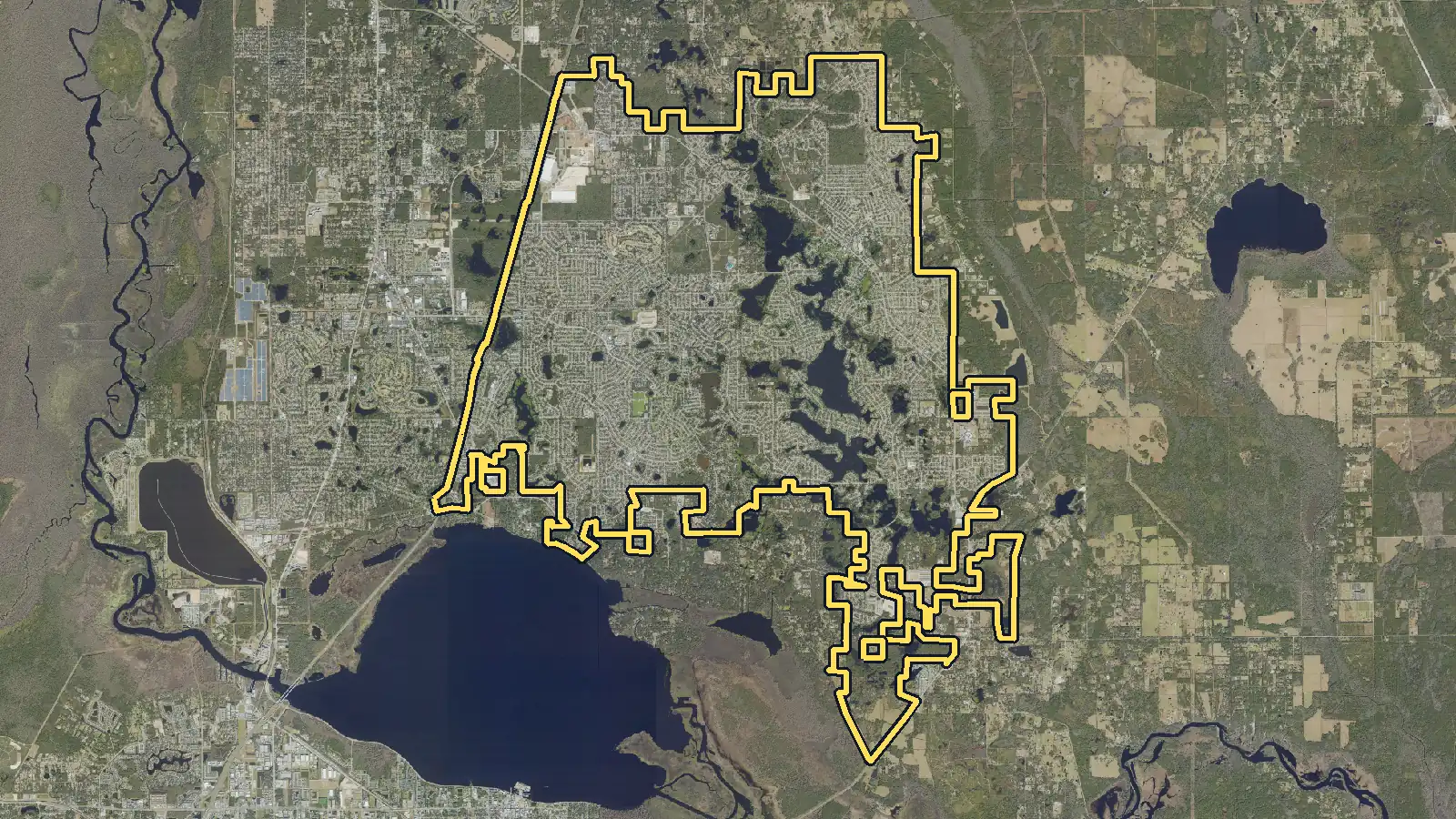
Volusia County, Florida
Sell your land in Deltona for cash
Parcel Buyers buys vacant lots in Deltona for cash, including original planned-community parcels where sewer availability, drainage and flood exposure differ by block. You get a written, no-obligation cash offer within 24 hours, and closings run through an independent title company, typically in about 10 days, with no fees or commissions.
By Parcel Buyers · · Lot figures from the 2026 Florida property tax roll · How we made this page
Quick answers
- Who buys land for cash in Deltona?
- Parcel Buyers is a direct land buyer that makes written, no-obligation cash offers on vacant lots and acreage in Deltona, Volusia County, usually within 24 hours. Sales close through an independent title company, typically in about 10 days, with no fees or commissions to the seller.
- What did vacant lots in Deltona sell for in 2025?
- In 2025, vacant lots in Deltona sold for a median of $70,000 across 69 arm's-length sales; the middle half sold for $60,000 to $80,000.
- How many vacant lots are in Deltona?
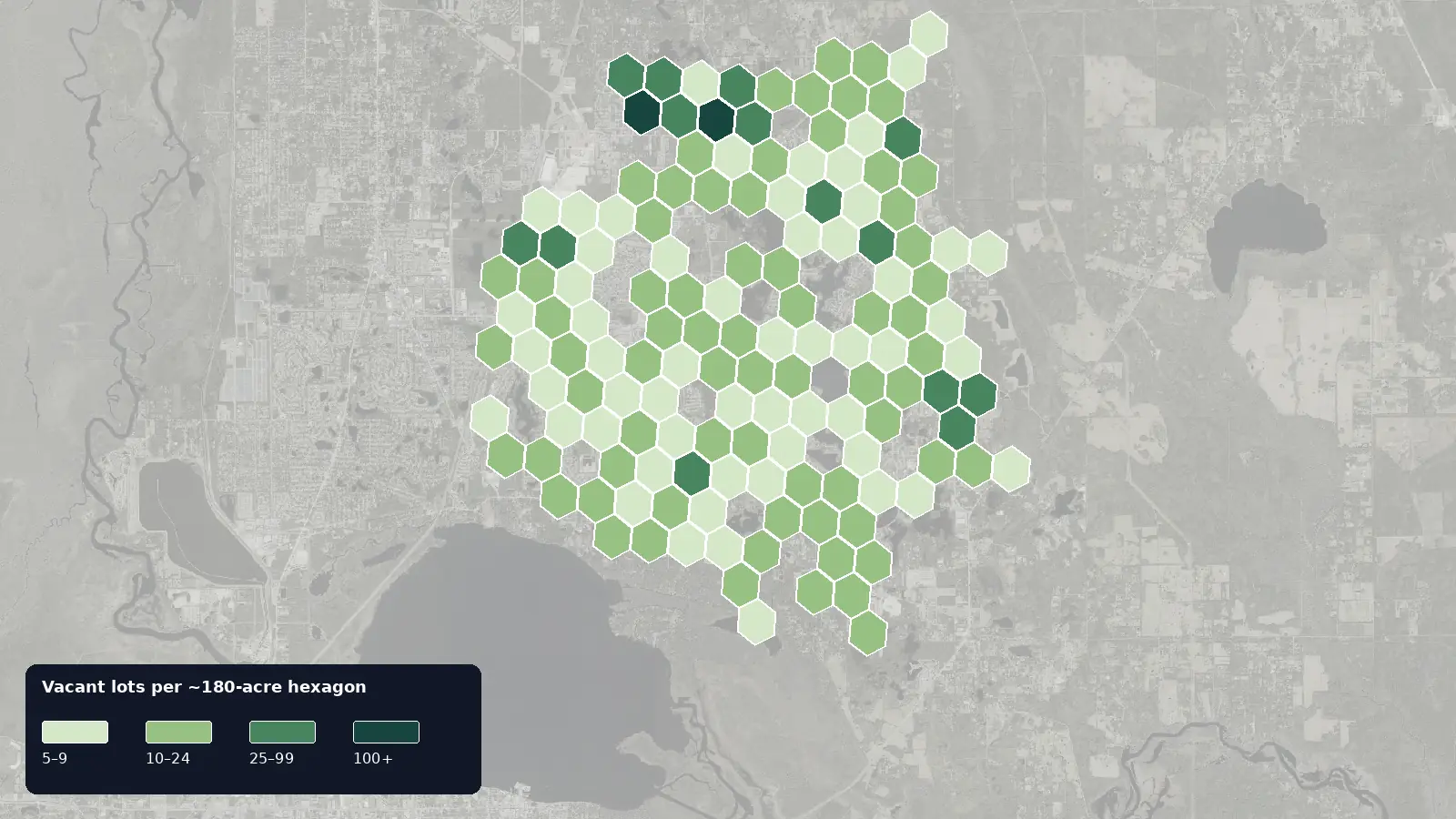
- The 2026 Florida property tax roll lists 2,426 vacant residential lots in Deltona; 35% are quarter-acre lots, and the median lot is 0.28 acre.
- How is a cash offer for land in Deltona set?
- We start from recent sales of similar lots nearby, like the 2025 prices on this page, then adjust for water and sewer, road access, flood zone, lot size and any title issues, and for the time and cost of reselling. You get one written number, not a range.
- How do I know a land buyer in Deltona is legitimate?
- A real buyer closes through an independent, licensed title company and never asks you to pay anything up front. We never charge sellers a fee, deposit or closing-cost advance, and the title company pays you by check or wire at closing.
- Who is buying lots in Deltona?
- In 2025, companies bought 58% of the vacant lots that sold in Deltona, including 52% bought by homebuilders. Individuals bought the rest.
- Are vacant lot prices in Deltona going up or down?
- Vacant lot prices in Deltona were roughly flat (+4.5%): the median moved from $67,000 across 71 recorded sales in 2024 to $70,000 across 69 recorded sales in 2025. These are recorded sales, not list prices. From January to May 2026, 30 vacant lots in Deltona sold at a recorded median of $65,000.
- Are vacant lots in Deltona in a FEMA high-risk flood zone?
- About 15.3% of vacant lots in Deltona have their center point in a FEMA high-risk flood zone (effective maps dated September 28, 2007 to September 29, 2017). This is map screening, not a determination; check FEMA's Map Service Center for your parcel.
- How many vacant lots in Deltona got a home on the tax roll in 2025?
- 106 vacant lots in Deltona changed from vacant-residential use to a home with new-construction evidence on the 2026 preliminary tax roll.
Local data
Deltona land at a glance
Tax-roll figures cover parcels whose property address city is Deltona in Volusia County. Local rules and services are sourced below.
| Vacant residential lots | 2,426 parcels classified vacant residential on the 2026 tax roll [1] |
|---|---|
| Most common lot size | Quarter-acre lot (9,000–13,000 sq ft): 35% of vacant lots; next, third-acre lot at 11%. Median lot: 0.28 acre (12,320 sq ft). [1] |
| Typical assessed value | $51,400 median just (market) value for a vacant lot; the middle half fall between $9,900 and $59,200 [1] |
| Recent lot sale prices | $70,000 median across 69 arm's-length sales of vacant lots in Deltona (Jan 2025–Dec 2025); the middle half sold for $60,000–$80,000 [1] |
| Who bought lots in 2025 | Companies made 58% of those purchases, including 52% by homebuilders; individuals made the rest [1] |
| Owners who live elsewhere | 36% of vacant lots have an owner mailing address outside Florida (most often TX, NY, NJ); 2% outside the U.S. [1] |
| A city since 1995 | Residents voted to incorporate in September 1995, and the City of Deltona officially began on December 31, 1995. City Building Services now handles permits and inspections. [2],[3] |
| More than 35,000 planned lots | The City's history says the Mackle Brothers bought 17,203 acres in 1962 and filed a planned development containing 35,143 lots. [2] |
| Sewer remains limited | The adopted infrastructure plan calls centralized sewer service near existing residential lots "very limited." Existing legal single-family lots may use septic when gravity sewer is not adjacent. [4] |
| Wells have lot-size conditions | The plan requires central water where available. On qualifying legally subdivided residential or agricultural lots of at least 2.5 acres, it allows an individual well when central water is unavailable. [4],[5] |
| Nearly 22% in mapped flood zones | The City says nearly 22% of its area lies in FEMA zones A, AE or X and warns that closed basins can create flood exposure even where land appears high and dry. [7] |
| Wetland review can join permits | The City's new-home checklist requires a wetland alteration permit when development is proposed within or next to a wetland, plus a tree-removal filing when protected trees are affected. [8] |
| Septic-to-sewer capital plan | The FY2025-26 capital plan lists $17.5 million over five years for citywide septic-to-sewer improvements and $35 million for wastewater-plant expansion; these are planned projects, not completed service. [9] |
| Lake Monroe | Lake Monroe forms Deltona's southern border. The City's hazard plan maps the 1% annual-chance flood area there and counts 5,646 Deltona parcels in the floodplain, making south-edge flood review parcel-specific. [10] |
| Lot sales, 2025 vs 2024 | 2025: 69 recorded sales, $70,000 median; 2024: 71 recorded sales, $67,000 median. Median +4.5%; count -2.8%. [1] |
| Vacant lots that got a home on the tax roll in 2025 | 106 recorded with new-construction evidence. [1] |
| Years of lot supply at the 2025 building pace | 22.9 years; simple ratio, not a forecast. [1] |
| Owner-type shares | Individuals 74.0%; companies 24.7%; trusts 0.7%; estates/heirs 0.4%; government/associations 0.1%. [1] |
| 2026 so far (Jan-May) | 30 recorded vacant-lot sales; median $65,000. [1] |
| FEMA high-risk flood-zone screen | About 15.3% of vacant lots in Deltona have their center point in a FEMA high-risk flood zone (effective maps dated September 28, 2007 to September 29, 2017). This is map screening, not a determination; check FEMA's Map Service Center for your parcel. |
| Springs BMAP small-lot screen | About 69.2% of located vacant lots in Deltona are 1 acre or less and have their center point in an adopted Florida springs BMAP. |
Pricing
What is a lot in Deltona worth?
In 2025, vacant lots in Deltona sold for a median of $70,000 across 69 arm's-length sales; the middle half sold for $60,000 to $80,000. [1]
These are open-market sale prices. A direct cash offer is usually lower, because a cash buyer closes in days and takes on the time and cost of reselling the lot. Homebuilders made 52% of the 2025 lot purchases in Deltona, and builder demand can lift sale prices above what a single owner usually gets from a cash buyer.
See what similar lots sold for
What moves the price in Deltona
Original plat history created a deep lot supply
The planned-community layout still shapes the land market. The City's history says the Mackle Brothers acquired 17,203 acres in 1962 and filed a development plan with 35,143 lots. Today's vacant inventory includes many similar residential parcels, so a buyer compares frontage, access, drainage, utilities and buildable area rather than paying for the city name alone. In this tax-roll scope, quarter-acre lots are the leading measured category at 35%. A corner site, extra width, an adjacent parcel under the same ownership or a clear connection path can separate one old plat lot from another. [2],[1],[6]
Sewer availability changes the building plan
Central sewer is not available beside every residential lot. The adopted infrastructure element calls sewer near existing residential parcels "very limited" and allows a legally subdivided single-family lot to use septic when a gravity line is not immediately available at the property boundary. New platted subdivisions follow a different rule and must have centralized sewer. Water also depends on actual service: existing wells may be upgraded where central water is unavailable, while connection is required where it is available. The specific line position must be verified before construction costs can be compared. [4],[5],[6]
Closed basins and wetlands narrow usable ground
Flood and wetland review can change how much of a parcel is usable. The City says nearly 22% of its area falls in FEMA A, AE or X zones and warns that a closed basin can flood land that looks like upland. Its new-home checklist requires a wetland alteration permit when work is proposed within or beside a wetland. The same package calls for a survey and plot plan that meet the City's lot-grading and driveway guidelines, plus either a septic permit with soil analysis or proof of sanitary sewer. Those requirements make elevation, drainage route and soil conditions direct parts of a builder's budget. [7],[8]
Builder activity raises the bar for comparison
Builders bought a large share of the 2025 sale set, but the tax roll does not identify which construction companies drove it. Of the 69 arm's-length, single-parcel sales of lots that remained vacant on January 1, 2026, the median was $70,000 and the middle half sold for $60,000–$80,000. The most common measured lots were quarter-acre lots. Those numbers show an active professional-buyer lane, not a guaranteed offer. A builder still discounts for septic or connection work, flood elevation, wetlands, trees, access and title. Parcel-specific conditions remain more useful than the citywide median. [1],[4],[8]
Common situations
Selling land in Deltona in these situations
You bought an old Deltona Corporation lot
Yes. You can sell an original planned-community lot without first proving that a house can be permitted. Tens of thousands of parcels were laid out after the developer's 1962 land purchase, and present conditions vary by street. City maps separately show zoning, flood zones, wetlands, future land use and water service. We check utilities, access and title on every parcel before offering. You do not need to order a soil test, extend a utility line or begin a building permit just to sell the land as it stands. [2],[6]
Your lot still uses the septic-and-well pattern
A lot without immediate sewer or water can still be sold. City policy allows septic on a legal single-family lot when gravity sewer is not adjacent. A new well is limited to qualifying legally subdivided residential or agricultural lots of at least 2.5 acres when central water is unavailable; an existing well may be upgraded when service is unavailable. A future home application then needs the septic permit and soil analysis or proof of sewer, plus the required survey and plot plan. Parcel Buyers buys vacant land with no water or sewer work completed. The seller does not need to install those systems before requesting an offer. [4],[8]
A flood or wetland map worries you
You can sell land that needs flood or wetland review. The City cautions that closed basins can create risk beyond what the ground looks like, and its residential checklist requires a separate permit when proposed development touches a wetland area. Our land inspection is the only contingency; a failed inspection costs the seller nothing. You do not need to clear trees, bring in fill or hire an engineer before asking for an offer. [7],[8]
Step by step
How do I sell my land in Deltona?
From your first message to money in hand, with nothing left out. Requesting an offer costs nothing and commits you to nothing.
See every detail of the process-
Tell us about your land
Fill out the short form (about 60 seconds) or email us. A land specialist reaches out to confirm the details, usually the same business day.
-
Get your cash offer within 24 hours
We review the property and send a written, no-obligation cash offer within 24 hours. It is a real number, not a range. Take it or leave it, with no pressure either way.
-
Sign electronically
If you accept, everyone signs the purchase agreement electronically. There is nothing to print or mail at this stage.
-
We inspect, the title company verifies
Our team inspects the land and an independent title company runs a title search for liens or taxes owed. If the land does not pass inspection, you are never charged anything.
-
Close and get paid
The title company prepares the closing documents for notarization and issues your funds by standard check, overnight check, or wire transfer. A typical sale closes in 10 days.
Questions
Selling land in Deltona: common questions
Does every vacant lot in Deltona have city sewer?
No. The City's adopted infrastructure element describes sewer near existing residential lots as very limited. A legal single-family lot may use septic when gravity sewer is not immediately available at its boundary, while new subdivisions must use centralized sewer.
Can I sell my Deltona lot before getting a septic permit?
Yes. A septic permit and soil analysis are part of a future house-permit package when sewer is unavailable, not a requirement for transferring vacant land. Parcel Buyers buys vacant lots with no water or sewer work completed, and checks utilities, access and title before offering.
Does a Deltona address prove my lot is outside a flood area?
No. The City says nearly 22% of its area is in mapped A, AE or X zones and warns that closed basins can expose land that appears high. Its maps provide a starting point, but the parcel boundary and elevation control the building review.
Are septic-to-sewer projects already serving every Deltona lot?
No. The FY2025-26 plan lists $17.5 million of septic-to-sewer improvements over five years, but a capital plan is not proof that a line is complete at a specific property. Current service availability still needs parcel-level verification.
What does Deltona require with a new-home permit package?
The City's checklist requires a survey and plot plan that meet its lot-grading and driveway guidelines, proof of sewer or a septic permit with soil analysis, and a wetland permit when proposed development lies within or beside a wetland. Tree and right-of-way documents can also apply.
Owner resources
Guides for your situation
- Can You Build on a Vacant Lot?
Maybe. A vacant lot is buildable only if the proposed use fits the rules that apply to that parcel and the site can satisfy access, utility, environmental, and permit requirements. Start with the local planning or zoning office, confirm that the parcel is a legal lot, and get a written parcel-specific answer. A zoning label or tax parcel number alone is not approval to build.[1][2]
- How to Sell Land With Wetlands
Yes, land with wetlands can be sold. Federal Section 404 regulates covered discharges of dredged or fill material, not the deed transfer itself.[3] Use the National Wetlands Inventory only for screening because it does not establish regulatory jurisdiction.[1] For parcel-specific boundaries, obtain field work and agency confirmation where needed.[2] Disclose known maps, studies, permits, enforcement notices, and prior fill work; do not promise buildability or permit approval.
- Water, Sewer, Septic, and Wells on Vacant Lots
A vacant lot may use public water, a private well, public sewer, or an onsite septic system, but nearby pipes and neighboring homes do not prove what the parcel can use. Ask each utility for a written availability decision, ask the permitting office whether connection is mandatory, and obtain a qualified site evaluation before saying septic will fit. Keep every response, permit, plan, test, and receipt.
More places in Volusia County
Your written offer
Get your cash offer
Four short steps, about 60 seconds. We review your property and send a written, no-obligation cash offer within 24 hours. You can take it or leave it.
What happens after you send this
- A land specialist reaches out, usually the same business day, to confirm the details.
- You get a written cash offer within 24 hours: a real number, not a range.
- You decide. Requesting an offer costs nothing and commits you to nothing.
You will never be asked to pay us anything. No deposit, no processing fee, no closing-cost advance.
Nearby areas we buy
- DeLand
8,498 vacant lots · 2025 median lot sale $40,000
- DeLeon Springs
2,003 vacant lots · 2025 median lot sale $147,500
- Volusia County
36,639 vacant lots countywide
How we made this page
Parcel Buyers is a land-buying company based in Florida. We buy vacant land directly from owners and publish these local pages so owners can see what land in their area is doing before they sell, to us or anyone else. We count the tax-roll figures ourselves from state data, take local rules and fees from the official sources listed below, and use AI tools to help research and draft the text. Every number links to its source, and we update the page when the data changes.
Method and sources
Tax-roll figures cover parcels whose property address city is Deltona. Source [1] is our own count of the Florida Department of Revenue's 2026 preliminary property tax roll: "vacant residential" means land-use code 000; lot sizes use the land square footage on the roll; values are the county property appraiser's just (market) value as of January 1, 2026; sale prices count only arm's-length sales of a single lot that was vacant when it sold and was still vacant on January 1, 2026 (bulk and multi-parcel deeds removed). Page updated October 2, 2026. Exact cross-roll matching found that 7.5% of current vacant lots lacked a unique prior-roll match; parcel splits, combinations, renumbering, and missing IDs are not guessed. The reviewed 2026 recorded-sale window runs from January through May 2026; unreviewed recent sales are excluded. Flood and springs-BMAP figures screen tax-roll parcel center points, not parcel boundaries. They are aggregate map screens, not flood-zone, insurance, buildability, elevation, septic, or permitting determinations.
- [1] Florida Department of Revenue (data); Parcel Buyers (analysis), Parcel Buyers analysis of the 2026 preliminary Name-Address-Legal (NAL) property tax roll (accessed 2026-10-03)
- [2] City of Deltona, City History (accessed 2026-09-30)
- [3] City of Deltona, Building Services Division (accessed 2026-09-30)
- [4] City of Deltona, Infrastructure Element (accessed 2026-09-30)
- [5] City of Deltona, Deltona Water and Wastewater Utility (accessed 2026-09-30)
- [6] City of Deltona, City Maps (accessed 2026-09-30)
- [7] City of Deltona, Flood Preparedness (accessed 2026-09-30)
- [8] City of Deltona, Residential New Construction Checklist (accessed 2026-09-30)
- [9] City of Deltona, FY2025-26 Adopted Budget in Detail (accessed 2026-09-30)
- [10] City of Deltona, Comprehensive Emergency Management Plan (accessed 2026-10-01)